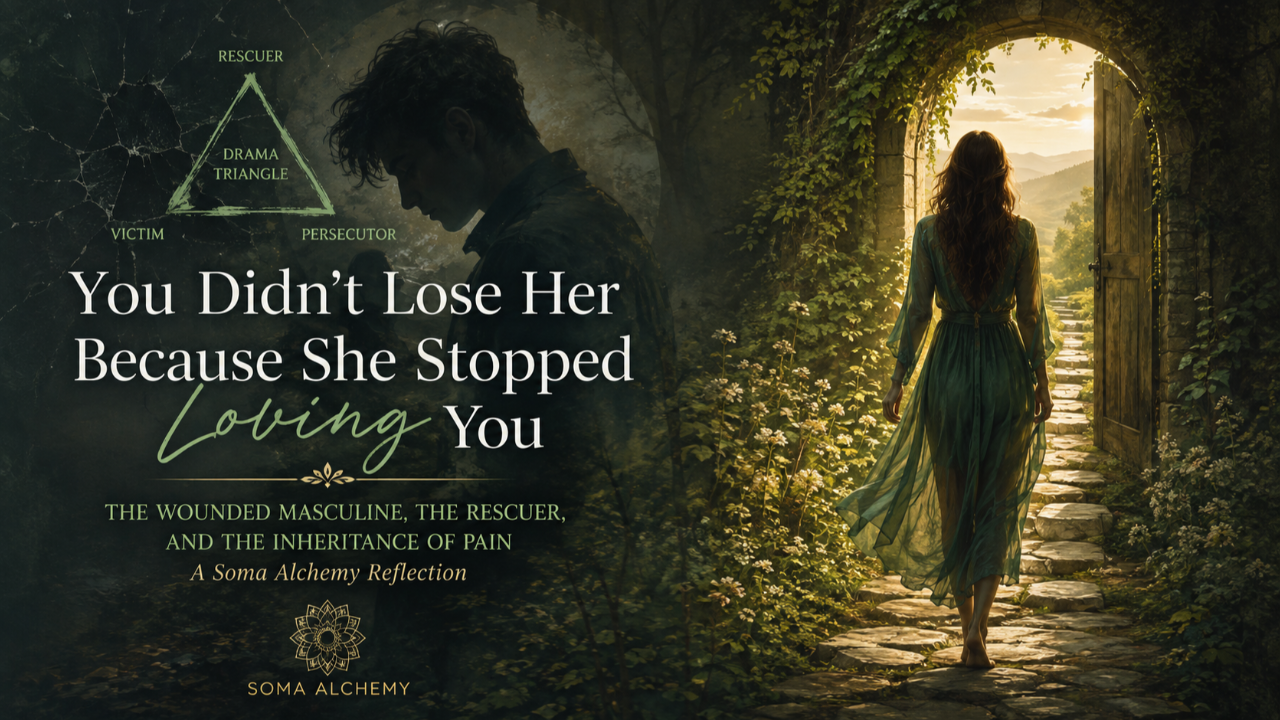
You Didn't Lose Her Because She Stopped Loving You
Aug 29, 2026The Wounded Masculine, the Drama Triangle, and the Woman Who Finally Stops Rescuing
There is a particular kind of heartbreak that comes from loving someone you can see so clearly.
You see the wound beneath the anger.
The fear beneath the avoidance.
The shame beneath the addiction.
The little boy beneath the man.
You see who he is.
And perhaps even more dangerously, you see who he could become.
For years, I loved a man whose wounds I understood almost as well as my own.
I understood the trauma.
I understood the addiction.
I understood the abandonment.
I understood the rage, the avoidance, the shame, the self-sabotage and the desperate need to escape himself.
And somewhere along the way, I confused understanding someone's wounds with having a responsibility to help heal them.
It would take me years to understand the difference.
When You Fall in Love With Potential
When I first met him, there was something about the connection that felt unlike anything I had experienced before.
I felt seen.
Not professionally.
Not as a mother.
Not as the woman who held everything together.
As me.
There was a familiarity to him that I still cannot completely explain.
Call it chemistry.
Attachment.
Nervous-system recognition.
Soul recognition.
Projection.
Something transpersonal.
Perhaps some combination of all of them.
Whatever language you choose, the experience was real to me.
And so was what happened next.
I eventually discovered that the reality I believed I was participating in was not the entire reality.
There was another woman.
Another life.
Things I didn't know.
Things I was told that weren't true.
And eventually, things I knew enough about that I had to make choices of my own.
I walked away.
And then, over the years, I returned.
More than once.
Because every time he came back, some part of me believed:
Maybe now.
Maybe now he is ready.
Maybe now he will choose differently.
Maybe now the man I can see underneath all of this will finally become the man he keeps telling me he wants to be.
But one of the hardest truths I've learned is this:
Potential is not proof.
Potential is not reality.
Potential is not capacity.
You can see extraordinary potential in another human being and still spend years loving someone who is not capable—or not yet willing—to live from it.
The Wounded Boy Inside the Man
Over time, I began to understand the pattern.
Love.
Avoidance.
Promises.
Inaction.
Connection.
Disappearance.
Truth.
Another discovery.
Another explanation.
Another chance.
Another wound.
And because I understood trauma, I could almost always understand why.
That became dangerous.
Because explanation can quietly become permission.
The more capable we become of understanding someone's trauma, the easier it can become to explain away what their unresolved trauma is doing to us.
At some point, that is no longer compassion.
It becomes participation.
There is a difference between understanding why someone behaves the way they do and volunteering to repeatedly absorb the consequences of that behavior.
Trauma may explain behavior.
Addiction may explain behavior.
Mental illness may explain behavior.
Attachment wounds may explain behavior.
None of them make harm disappear.
The Drama Triangle
There is a relational model known as the Drama Triangle, a pattern commonly seen within codependent relationships. In my work with students, clients and patients, I often refer to it more simply as “The Victim Trap.”
I call it a trap because once we enter the triangle, we can become caught in a cycle of three interconnected positions—Victim, Rescuer and Persecutor—each feeding the others as we move between them, often without consciously realizing it.
The Victim experiences themselves as powerless, hopeless or helpless—acted upon by life or by others, and believing they are unable to change what is happening. This position can include self-pity and a deeply internalized “poor me” or “sorry for myself” narrative.
The Rescuer steps in to save, fix, protect, manage or carry—often taking responsibility for what ultimately belongs to someone else. Although it may look and feel like helping, rescuing can cross into enabling, unintentionally protecting another person from the consequences that might otherwise create an opportunity for change.
The Persecutor occupies the blaming, controlling, punishing, judging or attacking position. The harm can be directed toward others or toward the self, and a person does not necessarily recognize that they are participating in it. Much of this pattern can operate outside conscious awareness.
These are not fixed identities. The roles can change quickly. A person may move from one position to another—even within the same relationship or conflict.
I became extraordinarily familiar with the Rescuer.
I believed that if I loved enough, understood enough, supported enough, forgave enough, provided enough stability and gave enough chances, eventually he would have enough safety to choose himself.
I believed that perhaps he simply needed one person who would not abandon him.
One person who understood what was underneath everything.
One person who could see beyond the behavior.
One person who believed in the man underneath the wound.
Me.
But sometimes rescuing someone from the consequences of their choices also rescues them from the very experiences that might require them to change.
And sometimes the person we believe we are saving is not the only person being kept inside the triangle.
So are we.
When Love Becomes Carrying
Over time, I wasn't simply loving him.
I was carrying.
Emotionally.
Financially.
Practically.
Energetically.
I carried hope when he had none.
I carried stability when his life was unstable.
I carried possibilities when reality kept showing me something different.
And I became extraordinarily skilled at surviving on breadcrumbs while remembering the feast I believed was possible.
There was always a reason to wait.
Once this problem is resolved.
Once he gets treatment.
Once the addiction is under control.
Once the depression lifts.
Once the legal problems are behind him.
Once he becomes stable.
Once he heals.
Once he is finally ready.
Then we begin.
Except my life had already begun.
And I was spending it waiting.
There is a point where supporting someone can quietly become carrying them.
And carrying someone long enough can make it difficult to recognize just how much of your own life you have put down in order to keep holding theirs.
When the Rescuer Finally Says No
Something strange happens when the person who has been rescuing finally stops.
To the person accustomed to being rescued, a boundary can feel like abandonment.
The person who once softened consequences, absorbed chaos, offered another chance and kept showing up suddenly becomes the problem.
Within the Drama Triangle, the Rescuer may even become the Persecutor in the other person's story.
You abandoned me.
You gave up on me.
You stopped believing in me.
You left when I needed you most.
You don't love me.
And that can be extraordinarily difficult for someone whose identity has become intertwined with being the one who stays.
Because now the boundary doesn't only activate the other person's wounds.
It activates yours.
The part of you that fears being selfish.
The part that feels guilty when someone else is hurting.
The part that believes love means staying.
The part that learned your value came from being needed.
The part that wonders whether one more conversation, one more chance, one more act of compassion might finally change everything.
This is why leaving a codependent dynamic is not simply about leaving another person.
You have to leave your role.
I had to stop rushing in.
Stop softening consequences.
Stop making things easier.
Stop explaining.
Stop carrying.
Stop waiting.
And perhaps most importantly, I had to stop making his healing the condition upon which I would finally allow myself to live.
That required me to ask a much harder question than Why does he keep doing this?
I had spent years asking that question.
The question that finally began changing me was:
What was my role in keeping this cycle alive?
But Aren't You Supposed to Know Better?
There is another question I know some people will ask.
Maybe some will say it aloud.
Others will simply think it.
Aren't you a mental-health professional?
Yes.
And not simply a professional who occasionally encounters trauma or addiction.
For more than two decades, I have worked in mental health, with much of my work centered around severe trauma, addiction and co-occurring disorders—the complicated place where mental-health conditions, trauma, substance use, attachment wounds and deeply ingrained survival patterns intersect.
This is not unfamiliar territory for me.
It is my specialty.
I understand addiction.
I understand trauma responses.
I understand attachment wounds.
I understand nervous-system dysregulation.
I understand denial, avoidance and shame.
I understand relapse.
I understand codependency.
I understand relational systems.
So how does someone who knows all of this end up here?
Because expertise does not erase attachment.
There is an analogy I have used many times with the people I work with:
Can a cardiologist perform their own heart surgery?
Of course not.
They may understand the anatomy of the heart better than almost anyone. They may recognize exactly what is wrong. They may know the procedure, the risks, the instruments and every step required to repair it.
But when it is their own heart on the table, they still need someone else.
Psychological healing is different from heart surgery, of course, but the principle has always helped me explain something important:
Knowing how healing works does not eliminate our need to be helped while we heal.
I can recognize a trauma response and still have one.
I can teach nervous-system regulation and still become dysregulated.
I can understand attachment wounds and still have my own activated.
I can recognize codependency and still discover places where I have participated in it.
I can help another person identify a pattern with remarkable clarity while needing someone outside of my own experience to help me see the places where my own vision has become clouded.
Professional training does not remove childhood wounds.
Clinical knowledge does not prevent a nervous system from responding to love, loss, fear, hope or abandonment.
And being a mental-health professional does not mean I am supposed to heal myself alone.
I don't ask that of the people I serve, and I don't ask it of myself.
I believe in the work I ask others to do enough to do it myself.
I seek help from my own profession.
I allow other professionals to challenge me, support me, reflect things back to me and help me see what can be extraordinarily difficult to see from inside my own life.
For me, that is part of practicing what I preach.
It is not evidence that my professional knowledge failed me.
It is evidence that I am human enough to need the same things I encourage others to seek.
And sometimes knowing more can actually give you more reasons to stay.
I could see the trauma.
I could see the abandonment.
I could see the shame.
I could see the addiction.
I could see the dysregulation.
I could see the defenses.
I could see the wounded little boy underneath it all.
And because I could understand so much of why it was happening, I became extraordinarily skilled at tolerating what was happening.
This is hurting me became I understand why he's doing this.
This behavior is unacceptable became He's dysregulated.
He is responsible for repairing what he has damaged became He's traumatized. He's ashamed. He's struggling. Give him time.
All of those explanations may contain truth.
And the behavior can still be unacceptable.
A diagnosis does not erase responsibility.
Trauma does not erase responsibility.
Addiction does not erase responsibility.
Mental illness does not erase responsibility.
They can profoundly affect a person's capacity, behavior and ability to make healthy choices.
But none of them require another human being to become collateral damage.
Knowing the psychology of a pattern does not make us immune to participating in it.
Knowing the map does not mean you cannot get lost.
And sometimes knowing the map means you can explain every landmark while you're getting lost.
Before You Judge Me, Look in the Mirror
Some people in my life could not understand why I stayed.
Some relationships in my own life changed because of it.
I know some of the judgments.
Maybe you've had them while reading this.
She's a mental-health professional. She should have known better.
He was married.
She knew.
Why did she keep going back?
Why would she believe him again?
She kept doing this to herself.
Or perhaps the simplest and cruelest judgment of all:
She was stupid.
I've thought some of those things about myself too.
And I'm not going to rewrite my history to make myself more comfortable for you to understand.
There were times I knew enough that I should have walked away.
There were times I believed things I desperately wanted to be true.
There were boundaries I established and later abandoned.
There were decisions I made that I would not make today.
There were times another woman was affected by choices in which I participated, even when I did not initially know the entire truth.
I am responsible for my part of that.
That's not shame.
That's accountability.
And there's a difference.
But here's where I want to invite you to do something more difficult than deciding what you think about me.
If you have judged me while reading this, don't immediately suppress the judgment.
Notice it.
Maybe even write it down.
Then remove my name from it.
Remove him.
Remove the marriage.
Remove the addiction.
Remove the particulars of my story.
And look underneath your judgment for the human behavior you're actually judging.
She knew better and did it anyway.
Then ask:
Where have I known better and done it anyway?
She kept returning to something that was hurting her.
Ask:
Where have I repeatedly returned to something I knew was hurting me?
She believed what she wanted to believe despite what was happening.
Ask:
Where have I ignored reality because the truth threatened something I desperately wanted?
She participated in something that hurt another person.
Ask:
Where have my choices caused harm that I justified, minimized or didn't fully acknowledge at the time?
And if your judgment was simply—
She was stupid.
Don't stop there either.
What does stupid mean in this context?
Ignoring something you knew?
Repeating a mistake?
Believing someone despite evidence that told you not to?
Choosing temporary emotional relief over a reality you weren't yet prepared to accept?
Perhaps you have never lived my particular story.
That's not the question.
Where does the behavior live in yours?
Where have you betrayed your own knowing?
Where have you remained somewhere after realizing it was hurting you?
Where have you rationalized something because acknowledging the truth would have required a change you weren't ready to make?
Where have you harmed yourself—or someone else—while trying to protect something you were afraid to lose?
And then comes the question that matters most:
Where am I still behaving this way?
Followed by:
What am I willing to do to heal and correct that part of myself?
Because accountability that only travels outward is judgment.
Accountability that travels inward becomes transformation.
This does not mean every behavior is equivalent.
It does not mean we assume responsibility for someone else's abuse.
It certainly does not mean that being harmed means we caused the harm.
It means self-reflection requires us to become as curious about our own patterns as we are about everyone else's.
So judge me if you need to.
Perhaps your judgment has something to teach you.
Mine certainly did.
The Hardest Person I Had to Look At Was Me
One of the most difficult lessons of my transpersonal training was learning to look beneath the labels I placed on other people and ask where the underlying human capacity existed within me.
Not because all actions are equivalent.
They aren't.
Not because accountability disappears.
It doesn't.
But because shadow work requires something much harder than identifying darkness in another person.
It requires finding the places where we participate in our own version of it.
It is relatively easy to identify dishonesty in someone else.
Much harder to ask:
Where have I lied to myself?
It is easy to recognize manipulation when we feel manipulated.
Harder to ask:
Where have I manipulated reality in my own mind because I needed the story to end differently?
It is easy to see when another person has abandoned us.
Harder to ask:
Where have I abandoned myself?
It is easy to recognize another person's attempts to control an outcome.
Harder to ask:
Where have I tried to control an outcome because accepting reality felt unbearable?
It is easy to identify betrayal.
Harder to ask:
Where have I betrayed my own knowing?
And perhaps one of the most uncomfortable questions for me:
Where had I become so focused on his problems, his wounds, his choices and his healing that I didn't have to fully confront my own?
That question changed something.
Because I had spent years studying his wounds.
Understanding them.
Explaining them.
Responding to them.
Trying to help heal them.
Eventually, I had to turn all of that curiosity around.
I had to ask:
What wound in me kept volunteering to carry them?
My Wounded Girl Had Been There Too
The more honestly I looked at my role in the cycle, the more I realized that the professional woman in me had never been the only one making decisions.
There was a younger part of me there too.
A girl who wanted the happy ending.
A girl who wanted home.
A girl who wanted a partner.
Safety.
To be chosen.
And perhaps even more importantly—
to be chosen and then remain chosen.
She was remarkably willing to wait for that ending.
Every new promise whispered:
Maybe this time.
Every period of closeness offered another glimpse of what could be.
Every return allowed hope to begin again.
And eventually I had to recognize something that was much more difficult than acknowledging his wounds:
I wasn't only waiting for him to choose me.
I was waiting for him to become someone whose choice could finally heal something in me.
That realization changed the question.
Instead of asking:
Why can't he become the man I know he could be?
I had to begin asking:
Why does some part of me still need him to?
Because underneath all of my understanding of his wounded boy was a wounded girl of my own.
She had her own history.
Her own attachment wounds.
Her own longing.
Her own ideas about what it meant to finally be loved, safe and chosen.
And she deserved my compassion too.
But she could no longer be allowed to make adult decisions from an old wound.
I had spent so much time hoping he would become the person who could finally give her what she had been waiting for.
Eventually, I understood:
That was never his job.
And healing him was never mine.
Love Is Not Enough
Here is another truth that took me a long time to accept:
I loved him.
I can acknowledge that without taking back a single boundary.
I don't have to rewrite the entire relationship as a mistake in order to leave it.
Not everything beautiful was fake simply because the relationship ultimately became harmful.
Love and dysfunction can exist in the same relationship.
Connection and incompatibility can exist at the same time.
Two people can profoundly affect one another and still be unable to build a healthy life together.
And sometimes love is real—
and love is still not enough.
Love does not cure addiction.
Love does not create accountability.
Love does not make someone tell the truth.
Love does not make someone ready.
Love does not turn insight into action.
Love does not create capacity where capacity does not yet exist.
And love does not require another person to become the potential we see inside them.
This is where I had to confront something about my own role too.
Women are not rehabilitation centers for wounded men.
And men are not projects for women to fix.
We can love someone and recognize their wounds without assuming responsibility for their recovery.
We can see the frightened child beneath an adult's behavior without making ourselves responsible for raising the adult they have become.
We can believe in someone's potential without making our own life the waiting room while they decide whether to become it.
There is a profound difference between supporting someone's healing and becoming responsible for it.
Support says:
I believe you can do this.
Rescuing says:
I will keep doing what you are not yet willing or able to do for yourself.
Support leaves responsibility where it belongs.
Rescuing quietly picks it up.
And eventually I had to put his back down.
Not because I stopped caring.
Not because I stopped understanding.
And not because the love had never been real.
But because his healing was his responsibility.
And my rescuing?
That was mine.
Love can walk beside another person.
It cannot walk their path for them.
And love certainly does not require you to be destroyed while waiting for someone else to decide to walk theirs.
Words Are Not Repair
There were a lot of words over the years.
Promises.
Intentions.
Plans.
Apologies.
Declarations of love.
Declarations of change.
Declarations that this time would be different.
And for a long time, words were enough to reopen hope.
Because words can describe intention.
Behavior reveals capacity.
Eventually I had to learn that wanting to change and actually participating in change are not the same thing.
Saying I love you is not repair.
Saying I'm sorry is not repair.
Saying I know I hurt you is not repair.
Saying I'm going to change is not repair.
Those words can be meaningful.
They can even be sincere.
But repair requires something more.
Repair requires accountability.
Consistency.
Truth.
Follow-through.
It requires the ability to tolerate another person's pain without immediately becoming defensive, shifting blame, escaping into substances, disappearing, attacking, or replacing accountability with another promise.
It requires staying present long enough to participate in repairing what your behavior helped break.
And perhaps most importantly, repair requires behavior that eventually makes the apology believable.
There came a point when I could no longer measure change by what he understood, intended or promised.
I had to measure it by what was actually happening.
Was the behavior changing?
Was there consistency?
Was there accountability without someone else having to demand it?
Was he participating in his own healing?
Was I experiencing something genuinely different—or simply hearing a different explanation for something painfully familiar?
Eventually, I reached a place where words could no longer earn another chance. Too many promises had been followed by the same behavior.
I didn't need another explanation.
I didn't need another promise.
I needed participation.
To the Man Who Says She Abandoned Him
And now I want to speak directly to the man who recognizes himself somewhere in these words.
Especially the man who believes a woman who deeply loved him walked away.
You may tell yourself she abandoned you.
That she stopped loving you.
That she became cold.
Unforgiving.
Demanding.
Impossible to please.
Maybe she didn't leave because she stopped loving you.
Maybe she left because loving you had begun to require abandoning herself.
She may have spent years learning your wounds.
Understanding your trauma.
Holding space for your pain.
Seeing the frightened little boy underneath the behavior of the grown man standing in front of her.
She may have forgiven things she never imagined she would forgive.
She may have believed in your potential long after your behavior gave her reasons not to.
She may have stayed because she could see the person underneath everything you were doing to survive yourself.
But there is something even the deepest love cannot do.
No one can love another human being into choosing himself.
Eventually, you may lose her not because your wounds made you unlovable.
Not because you were too damaged to deserve love.
Not because she failed to understand what happened to you.
You may lose her because eventually your wound required too much collateral damage.
And if your response to her finally saying enough is to focus entirely on what she did to you rather than becoming curious about what your choices did to her, the wound may still be speaking.
If you blame her—
the wound may still be speaking.
If you experience her boundary only as something being done to you—
the wound may still be speaking.
If you escape into substances, rage, another relationship, isolation, self-pity or another person willing to rescue you—
the wound may still be speaking.
But eventually, the adult has to take responsibility for what they do from the wound.
She did not owe you her destruction as proof of her love.
She did not owe you another year because you had a difficult childhood.
She did not owe you another chance because this time you were finally ready.
She did not owe you continued access to her because losing that access hurt.
And she did not owe you becoming the container for pain you were unwilling—or not yet ready—to carry yourself.
The tragedy isn't simply that you lost her.
The tragedy would be losing her and learning nothing.
Because without awareness, the faces can change while the pattern remains.
A different woman.
The same wound.
The same triangle.
The same promises.
The same destruction.
The same goodbye.
So perhaps the question is no longer:
Why does everyone leave me?
Perhaps the question becomes:
What keeps happening inside me that makes healthy love impossible to sustain?
That question is not condemnation.
It is an invitation.
Because the wounded boy does not have to remain wounded forever.
But eventually the man has to decide whether he will continue protecting the wound—
or begin healing it.
Your Wound Is Not Your Fault. What You Do With It Is Your Responsibility.
I have worked with enough men to know that many are carrying pain they were never taught how to name.
Abandonment.
Abuse.
Neglect.
Rejection.
Shame.
Fear.
Grief.
Some were taught that vulnerability was weakness.
That emotions should be controlled, hidden or ignored.
That asking for help meant failure.
That being a man meant enduring pain silently rather than learning how to move through it.
So they learned other ways to survive.
Some numb.
Some rage.
Some disappear.
Some work.
Some use substances.
Some use sex.
Some disappear into technology.
Some avoid intimacy altogether.
Some desperately seek connection and then destroy it when it becomes too vulnerable.
I have tremendous compassion for the wounded person underneath these behaviors.
My professional work has taught me that healing is rarely as simple as telling someone to make better choices.
People develop survival strategies for reasons.
Sometimes those strategies helped them survive circumstances they genuinely did not know how to survive any other way.
But a survival strategy can eventually become the very thing destroying the life you are trying to survive.
And this is where compassion and accountability have to exist together.
Compassion and accountability are not opposites.
A person may not have chosen what happened to him.
He may not have created the wound.
He may not have deserved what was done to him.
But he is still responsible for what he does with what happened to him.
There comes a point when the question can no longer remain:
Why am I this way?
Understanding why matters.
But eventually another question has to follow:
What am I going to do about it?
Because an unhealed wound rarely remains contained within the person carrying it.
It enters relationships.
Partnerships.
Parenting.
Families.
It can become addiction.
Avoidance.
Rage.
Control.
Emotional absence.
Codependency.
And eventually, what began as one person's wound can become someone else's inheritance.
A partner carries it.
A child adapts to it.
A family organizes itself around it.
And another generation learns how to survive something they did not create.
That is how wounds become inheritance.
And somebody has to decide:
It stops here.
The Woman Who Stops Rescuing
Eventually, I did.
I stopped rescuing.
That did not mean I stopped loving him.
It did not mean I stopped understanding him.
It did not mean I could no longer see the wounded boy beneath the man.
It meant I finally stopped believing that understanding his wounds obligated me to remain wounded by them.
There is an enormous difference.
For years, I believed leaving meant giving up on him.
Eventually I understood that staying had required me to keep giving up on myself.
So I stopped.
I stopped trying to create consequences he would not create for himself.
I stopped trying to convince him of what his life could become.
I stopped measuring his potential.
I stopped waiting for promises to become behavior.
I stopped making room for a future that repeatedly failed to arrive.
And I stopped making his timeline my own.
He was allowed to take as much time as he needed to figure out his life.
I simply was no longer required to wait beside him while he did it.
That distinction gave something back to both of us.
His life belonged to him.
His choices belonged to him.
His consequences belonged to him.
His healing belonged to him.
And my life belonged to me.
I could no longer put my own healing, happiness and future on hold while waiting to see what he would choose to do with his.
For years, I imagined that if the relationship ever truly ended, there would be some profound final conversation.
Some moment when everything would finally be understood.
Some acknowledgment.
Some perfect goodbye.
There wasn't.
There were only a few words.
And then silence.
Strangely, that became enough.
Because for years I thought closure would come when he finally understood what he had done.
I know now that closure came when I no longer needed him to.
I didn't need him to agree with my boundary for the boundary to be valid.
I didn't need him to understand my decision for me to make it.
I didn't need him to acknowledge my pain for the pain to have been real.
And I didn't need him to become the man I once believed he could be in order for me to finally become the woman I needed to be.
Maybe This Is What Stopping the Inheritance Looks Like
Maybe stopping the inheritance doesn't always look like reconciliation.
Maybe sometimes it looks like loving someone and leaving anyway.
Maybe it looks like seeing the wounded boy inside the man while still holding the adult accountable for what he does with the wound.
Maybe it looks like having compassion without becoming the container.
Maybe it looks like grieving someone's potential without continuing to confuse it with their reality.
Maybe it looks like acknowledging the places where I abandoned myself without making myself responsible for the ways someone else harmed me.
Maybe it looks like owning the choices I made without turning accountability into shame.
Maybe it looks like telling the truth in both directions.
I can love him.
I can understand him.
I can have compassion for what happened to him.
I can grieve what happened between us.
I can acknowledge that some of what we shared was beautiful.
I can take responsibility for the places where I participated in an unhealthy cycle.
And I can still close the door.
Those truths do not cancel one another.
Healing does not require us to divide every story into one good person and one bad person.
It does not require purity.
It does not require perfection.
It requires consciousness.
Responsibility.
Choice.
And sometimes the willingness to finally stop participating in what we now understand.
Because this is what I know today:
Love is not rescue.
Understanding is not permission.
Compassion is not self-abandonment.
Connection is not capacity.
Potential is not reality.
And another person's refusal—or inability—to heal does not require us to remain wounded beside them.
Maybe stopping the inheritance means stepping outside the triangle.
Looking honestly at the other person.
Looking just as honestly at ourselves.
Loving what was real.
Grieving what never became real.
Taking responsibility for what belongs to us.
And returning what never belonged to us in the first place.
I spent years believing I was waiting for him to change.
In the end, the person I was actually waiting for was me.
The woman who would finally trust what she knew.
The woman who could love without rescuing.
The woman who could understand without excusing.
The woman who could have compassion without abandoning herself.
The woman who could stop waiting for someone else to become ready before choosing her own life.
Maybe that is what breaking a generational cycle actually looks like.
Not erasing the wound.
Not pretending it never happened.
Not rewriting the story so that I was innocent of every choice or he was responsible for every pain.
But becoming conscious enough to stop handing the wound forward.
It stops here.
Somebody has to stop the inheritance.
This time, I realized that somebody was me.
Maybe that's why we're here.
— Soma Alchemy
STAY CONNECTED TO SOMA ALCHEMY
Receive new Journal writings, Institute updates, upcoming offerings, and thoughtful resources exploring healing, transformation, and conscious living.
Your inbox is sacred, too. No spam. Your information will never be sold or shared.