
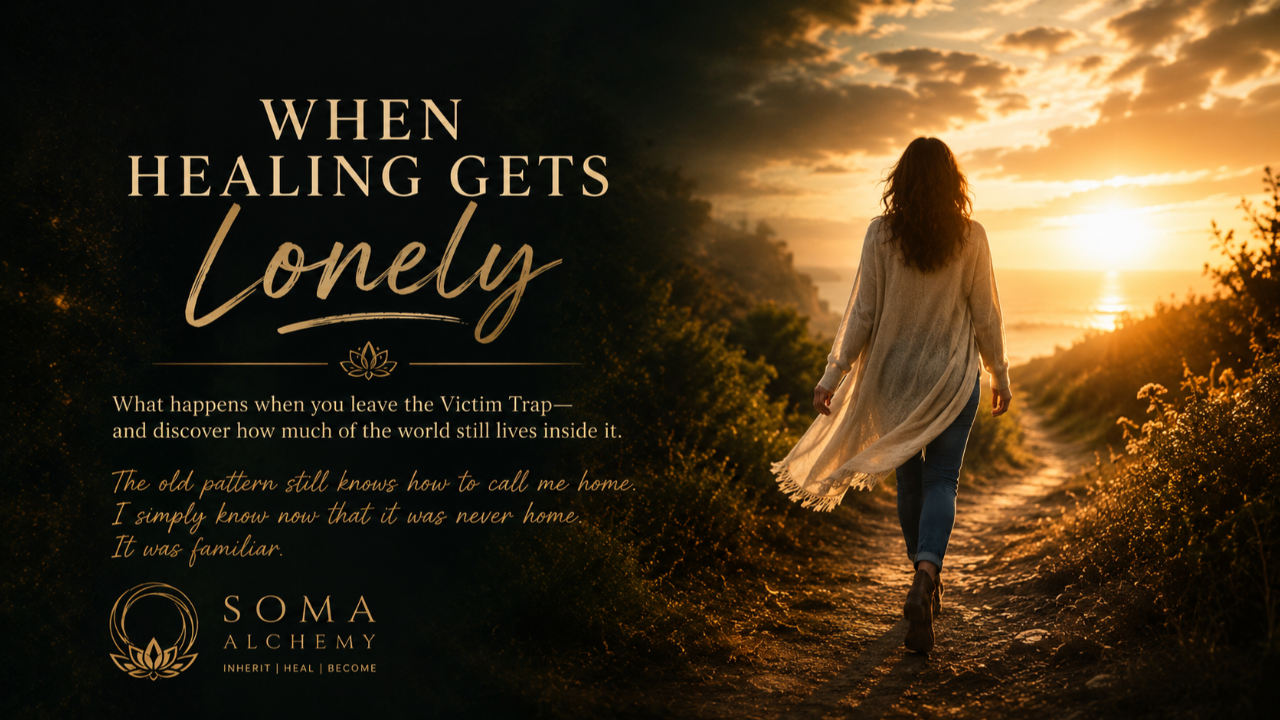
When Healing Gets Lonely
Sep 01, 2026What Happens When You Leave the Victim Trap—and Discover How Much of the World Still Lives Inside It
There are moments when doing the work feels profoundly unfair.
Not because I don't believe in it.
Not because I don't know how to do it.
And certainly not because I haven't spent years asking other people to do the same.
But because there are moments when I am regulating my nervous system, examining my shadow, questioning my own story, taking responsibility for my choices, resisting the urge to rescue, refusing the invitation to persecute, and pulling myself out of the Victim Trap—
and some deeply human part of me wants to scream:
Why the fuck am I doing all of this when it would be so much easier not to?
There.
I said it.
Because I think we need to talk about this part of healing too.
We talk about awareness.
Boundaries.
Nervous-system regulation.
Shadow work.
Accountability.
Breaking generational cycles.
Becoming conscious.
But we don't talk nearly enough about what happens when you actually begin doing those things and discover that consciousness doesn't necessarily make life easier.
Sometimes it makes life more complicated.
Sometimes healthier action brings grief.
Sometimes boundaries bring loneliness.
Sometimes accountability means surrendering the comfort of blame.
Sometimes leaving an old pattern means standing in an empty space without knowing what replaces it.
And sometimes the old way looks really fucking tempting.
Because the old pattern served a purpose.
Chasing gave anxiety somewhere to go.
Rescuing created purpose.
Rage protected grief.
Blame protected us from examining our own participation.
Helplessness relieved us, temporarily, from the terrifying responsibility of choice.
And when those things disappear, peace isn't necessarily the first thing waiting for us.
Sometimes loneliness is.
Where I Learned to See the Trap
I did not create the Victim Trap.
I was introduced to this framework through my training at The Wellness Institute and the work of its co-founder Diane Zimberoff, author of Breaking Free From the Victim Trap: Reclaiming Your Personal Power.
That distinction matters to me.
What I have done over the years is take that foundation into my own clinical work and continue developing the ways I teach people to recognize these patterns in everyday life.
Because I was seeing them everywhere.
In trauma.
Relationships.
Families.
Workplaces.
Codependency.
Mental health.
Helping relationships.
Recovery.
And eventually—
in myself.
One way I began making the pattern visible was through language.
Should.
Could.
Would.
Can't.
Try.
Maybe.
But.
Wish.
Hope.
Pray.
I don't know.
Whatever.
Why.
Sorry.
I'm alone.
No one understands.
These are not bad words.
They are not forbidden words.
The word is not the trap. The word is the bell.
It is an invitation to pause and ask:
What is happening here?
Where is my agency?
Am I describing reality—or surrendering responsibility for the part of reality I can influence?
Am I holding someone accountable—or persecuting them?
Am I taking responsibility—or shaming myself?
Am I supporting someone—or rescuing them from something that belongs to them?
Am I surrendering what I cannot control—or surrendering responsibility for what I can?
The language isn't the problem.
The language helps us notice where to look.
When Explanation Becomes Identity
Years ago, when I was experiencing significant Crohn's disease flare-ups, I would say:
“My Crohn's.”
It seemed completely ordinary.
But as I became more conscious of language and attachment, I began hearing what I was actually saying.
My Crohn's.
So I began changing the sentence.
Instead of:
“My Crohn's is bad right now.”
I could say:
“I have a diagnosis of Crohn's disease.”
The medical reality hadn't changed.
Crohn's didn't disappear because I changed my language.
What changed was my psychological relationship to it.
I am more than the thing happening to me.
That distinction became increasingly important as I listened to people say:
I am an alcoholic.
I am an addict.
I am bipolar.
For some people, identity language creates belonging, recognition and accountability. I am not interested in taking useful language away from anyone.
I am interested in what happens when an identity that initially creates understanding begins creating limitation.
The same thing can happen with trauma.
A diagnosis.
An attachment style.
Childhood.
A nervous-system explanation.
Spirituality.
Even therapy.
I'm avoidant.
That's my nervous system.
That's because of my childhood.
Every statement may contain important truth.
And every explanation can become a hiding place if the conversation always ends there.
Eventually another question has to follow:
Now that I understand why, what am I going to do with it?
That isn't shame.
That's agency.
When Surrender Becomes Another Place to Hide
Some of the most complicated conversations I have had about agency have happened in addiction recovery.
This isn't because I am opposed to recovery communities.
I'm not.
Twelve-step programs can provide fellowship, structure, accountability, identification and a place where people struggling with addiction no longer have to believe they are alone.
But after more than twenty years specializing professionally in severe trauma, mental health, addiction and co-occurring disorders, I have also seen how easily surrendering what we cannot control can become confused with surrendering responsibility for what we can.
Those are not the same thing.
Surrender is not helplessness.
And powerlessness does not have to become an identity.
I don't understand this only because I have spent more than twenty years sitting across from people struggling with addiction.
I understand it because addiction belongs to my story too.
It runs through my family line.
I have faced my own relationship with addiction, numbing and the ways human beings reach for something—anything—that gives temporary relief from what we don't yet know how to feel.
And when I look honestly at my own life, some of my most persistent compulsive patterns were never about a substance.
I could become consumed with rescuing.
Being needed.
Helping.
Fixing.
Focusing so intensely on someone else's crisis that I didn't have to remain fully present with what was happening inside of me.
Food became part of that story too.
I come from an Italian family culture where food meant so many beautiful things—love, family, gathering, celebration, connection, comfort.
But I also learned that food could become somewhere to put feelings.
Eat.
Feed someone.
Keep moving.
Push it down.
Swallow it.
Sometimes literally.
That isn't a statement about all Italian families. It is an honest examination of what I learned to do with food.
Something outside of me could change what I felt inside of me.
And isn't that one of the questions beneath so many compulsive patterns?
What am I reaching for so I don't have to feel what is here?
Sometimes it was food.
Sometimes another person.
Sometimes rescuing.
Sometimes being desperately needed.
Different behavior.
Similar invitation to leave myself.
That doesn't make every compulsive behavior a clinical addiction.
It means removing one behavior does not automatically resolve every wound, attachment pattern, shame response or survival strategy beneath it.
And after all these years of training, therapy, clinical work, shadow work and personal healing, I would love to tell you I have overcome every one of mine.
I haven't.
What has changed is that I can hear the bell sooner.
Let Go and Let God
There is wisdom in surrender.
I cannot control another human being.
I cannot control whether someone tells the truth.
I cannot control whether someone chooses recovery.
I cannot rewrite childhood.
I cannot undo yesterday.
There can be tremendous freedom in releasing the illusion that I can.
But surrender can also become another place to hide.
I'll pray about it.
Hopefully things change.
Maybe someday.
I wish things were different.
And that's when I ask:
What is mine to do?
Prayer can accompany agency.
Hope can sustain agency.
Faith can strengthen agency.
Surrender can help us distinguish what belongs to us from what never did.
Sometimes I can pray for the door to open.
And sometimes I need to get up and turn the fucking doorknob.
Both can be sacred.
Because a goal without a plan is still a wish.
For me, the question isn't whether I believe in something greater than myself.
I do.
The question is whether that belief deepens my participation in my own life—or becomes somewhere I outsource it.
God is not the problem. The outsourcing of agency is.
I can surrender the outcome without surrendering responsibility for the choices that belong to me.
Accountability Is Not Persecution
Once we begin talking about responsibility, another distinction becomes essential.
Accountability is not shame.
I can acknowledge that I hurt someone without deciding I am a horrible person.
I can recognize a destructive choice without sentencing myself to self-hatred.
I can understand how trauma influenced my behavior without expecting another person to absorb the consequences of it.
Accountability examines behavior.
Persecution attacks identity.
Persecution says:
You should've known better.
You could've stopped.
You would've done differently if you actually cared.
And sometimes the most vicious Persecutor in the triangle lives inside us.
I should've left sooner.
I should've known.
I could've prevented this.
Should.
Could.
Would.
The bell.
There is a difference between:
I should have known then.
and:
I know now.
One persecutes the person I was.
The other gives agency to the person I am becoming.
I cannot use today's consciousness to punish yesterday's version of myself for not possessing it.
And even when I know better, I will not execute the healthier choice perfectly every time.
Trauma does not disappear because I can name it.
A nervous system does not immediately reorganize because I understand why it became dysregulated.
Attachment wounds do not stop activating because we discussed them in therapy.
Awareness does not instantly create capacity. But awareness changes our relationship with responsibility.
Maybe healing isn't proving I never enter the pattern again.
Maybe healing is recognizing when I have—and choosing what I do next.
When Therapy Enters the Triangle
Helping professionals are not immune from any of this.
We validate.
Empathize.
Normalize.
Explain.
Advocate.
All of those things can be therapeutic.
But helping is not automatically healing.
Sometimes, without realizing it, the helper can become part of the very triangle we are trying to help someone escape.
Validation matters profoundly, especially for people whose emotions have been dismissed, minimized or shamed.
Sometimes another human being needs to say:
“What happened to you mattered.”
“Your feelings make sense.”
“I believe you.”
There is healing in that.
But:
“Your feelings make sense” does not mean “everything you believe about what happened is objectively true.”
I can say:
Of course that activated you.
And still ask:
What did you do when you became activated?
I can understand the anger and still ask what happened with the anger.
I can validate the fear of abandonment and still become curious about whether someone withdrew, chased, attacked, rescued, controlled or assumed.
Validation says:
Your experience deserves to be understood.
Accountability asks:
What are you going to do with what you now understand?
And this distinction matters enormously in trauma work.
A person can be genuinely victimized.
Someone can be abused, assaulted, deceived, exploited, neglected, manipulated or harmed.
They are not responsible for another person's decision to harm them.
Being harmed is not the same thing as occupying the Victim position in the Drama Triangle.
The question is never:
How did you cause what happened to you?
Sometimes the answer is simply:
You didn't.
The healing question comes afterward:
What belongs to me now?
What do I need?
What choices are available?
What boundary needs to exist?
What support do I need?
What am I responsible for healing?
What do I do with what I now know?
We can validate the wound without teaching someone to build an identity around the wound.
Responsibility is not blame.
The Helper Has Shadow Work Too
The Drama Triangle does not disappear because one person in the room has a license.
Clinicians have nervous systems too.
Histories.
Wounds.
Biases.
People whose stories remind us of our own.
Clients we desperately want to succeed.
The client can become Victim.
The absent spouse, parent, boss, ex or institution becomes Persecutor.
And the therapist quietly becomes Rescuer.
Sometimes rescuing looks remarkably similar to helping.
That's what makes it difficult to recognize.
We can work harder than the person we're helping.
Construct every boundary.
Interpret every interaction.
Provide every answer.
Reassure every fear.
And because it comes from a genuine desire to care, we can call all of it therapeutic.
So I have to ask myself:
Am I supporting this person's agency, or am I slowly carrying it for them?
There have been times in my career when I have worked harder for someone's healing than they were.
And there have been times in my personal life when I have done exactly the same thing.
Different relationship.
Different setting.
Same pattern.
A therapist who continually carries someone's agency may unintentionally make it harder for that person to develop their own.
The goal is not dependence upon my ability to understand their life.
We have to be willing to become less necessary.
And that has its own shadow.
Being trusted feels good.
Being the safe person feels good.
Being needed can feel meaningful.
Therapists are human beings.
So the Victim Trap doesn't only ask us to examine our clients.
It asks the helper to examine the helper.
The Intake Question That Told Me So Much
For years, I have asked a question during intake:
“What did you not like about the previous therapists you worked with?”
Sometimes the complaints are completely legitimate.
Poor fit exists.
Over-disclosure exists.
Stagnant therapy exists.
Providers can fail to listen, challenge, teach, refer or recognize when their approach isn't helping.
I know because I have sat in the other chair too.
But then I ask:
“Did you discuss these concerns with your therapist?”
And so often there is a pause.
Well...no.
Then the bells begin.
I could've, but...
I didn't think they would listen.
I shouldn't have to tell them.
They should've known.
That is not proof the therapist did nothing wrong.
It is not proof the complaint isn't valid.
It opens another question:
Where was your agency inside the relationship?
Did you tell them?
Did you ask for something different?
Did you say you felt unheard?
And if you couldn't—
what made that unavailable to you?
Maybe speaking up didn't feel safe.
Maybe assertiveness had been punished before.
Maybe there was a trauma response.
Maybe the power differential mattered.
Maybe the person lacked the skills.
Maybe they had learned that having needs made them difficult.
That is clinically meaningful information too.
Suddenly we aren't only talking about the previous therapist.
We may be discovering what happens whenever this person needs something from another human being.
Perhaps they don't tell their partner.
Perhaps they avoid conflict with family.
Perhaps they remain silent at work until resentment explodes.
Perhaps they expect people to recognize needs they haven't expressed.
That's why the therapy relationship itself can become one of the safest places to practice agency.
Tell me when something isn't working.
Tell me when you're angry.
Tell me when you disagree.
Tell me when I got it wrong.
Tell me what you need.
And then let's see what happens when you use your voice.
Validation Is Not Transformation
I tell people from the beginning:
This is going to be work.
Relationship comes first.
Safety matters.
Validation matters.
Being witnessed matters.
Sometimes grieving is the work.
Sometimes surviving the week is the work.
Not every session needs homework.
But I am also not interested in helping someone become extraordinarily sophisticated at explaining a pattern while continuing to live inside it.
We can know every word.
Trauma response.
Attachment wound.
Dysregulation.
Trigger.
Projection.
Codependency.
Inner child.
Nervous system.
Boundaries.
And still repeat the pattern.
The goal of therapy should not be to become better at explaining the pattern. At some point, we have to become capable of interrupting it.
Not perfectly.
Maybe we notice sooner.
Maybe we stay in it for three hours instead of three days.
Maybe we recognize the urge before acting on it.
Maybe we apologize without collapsing into shame.
Maybe we recognize rescuing while we're doing it instead of six months later.
Maybe we regulate enough to make one different choice.
That counts.
Transformation isn't always:
I never did it again.
Sometimes it begins:
I caught myself doing it.
Then:
I understood what was happening.
Then:
I took responsibility.
Then:
I practiced something different.
And eventually something different became available when I actually needed it.
The Therapist Cannot Do My Reps
I often compare psychotherapy to physical therapy.
A physical therapist can assess the injury.
Teach exercises.
Correct form.
Adjust treatment.
Explain what is happening.
But eventually—
I have to do the reps.
Psychotherapy isn't all that different.
There are 168 hours in a week.
I may spend one of them with a patient or client.
That hour matters.
The relationship matters.
Insight matters.
Validation matters.
Safety matters.
Skills matter.
And the other 167 hours matter too.
I can teach nervous-system regulation.
I cannot regulate someone's nervous system for them when the trigger comes.
I can teach assertive communication.
I cannot use their voice when they are afraid to speak.
I can help someone recognize the Victim Trap.
I cannot interrupt their role for them on Tuesday afternoon.
I can help identify a boundary.
I cannot hold it when someone becomes angry about it.
I can help someone understand why a survival pattern developed.
I cannot practice the new pattern for them.
The therapy room is where we learn and practice.
Life is where we discover what has actually become available to us.
Sometimes life shows us the skill isn't available yet.
That's information.
Not failure.
We come back.
We examine what happened.
We adjust.
We practice again.
Because ultimately:
A physical therapist cannot strengthen the muscle for me.
A psychotherapist cannot practice my agency for me.
Or, in the simplest language I know:
The therapist cannot do my reps.
And Then I Wanted to Go Back
And this is where all of that professional language becomes painfully personal.
Because sometimes you can understand the pattern.
Recognize the Victim Trap.
Regulate your nervous system.
Examine your shadow.
Stop rescuing.
Communicate what you need.
Set the boundary.
Refuse to chase.
Take responsibility for your choices without taking responsibility for someone else's.
You can do everything you have spent years learning how to do.
And it can still fucking hurt.
Sometimes the immediate reward for doing the work isn't peace.
Sometimes it's grief.
Silence.
Loneliness.
An empty space where another person used to be.
The ache of loving someone and knowing that love alone cannot create the relationship you need.
And then comes the thought nobody likes admitting:
Fuck this. I could make this stop.
Because I know how.
Reach out.
Soften the boundary.
Explain one more time.
Reassure someone out of their shame.
Make their pain more important than mine.
Take just enough responsibility for the rupture that maybe neither of us has to sit inside it anymore.
I know how to rescue.
I have had a lifetime of practice.
And suddenly the physical-therapy analogy isn't something I teach.
I'm the one holding the exercise.
Knowing what to do does not make doing it painless.
Agency does not mean the choice feels good.
A boundary does not remove attachment.
Regulation does not eliminate grief.
Consciousness does not silence the part of us that wants relief.
Sometimes doing the work means knowing exactly which old behavior would temporarily make the feeling disappear—
and choosing not to use it.
That's a different kind of withdrawal.
Not necessarily withdrawal from a person.
Withdrawal from a pattern.
From chasing.
Fixing.
Rescuing.
Explaining.
Controlling the outcome.
And without those behaviors, there I am.
No clinical language to hide behind.
No one else's nervous system to regulate.
No crisis to solve.
Just me.
The grief.
And the fucking silence.
Sometimes there is simply a woman sitting alone with every cell in her body wanting to return to what is familiar—
and choosing, for one more moment, not to.
That is a rep too.
Familiar Is Not the Same as Safe
The old pattern was never completely useless.
If it had been, I wouldn't have kept returning to it.
Chasing gave anxiety somewhere to go.
Rescuing gave Cathy the Caretaker purpose.
Explaining created the illusion that the right words might change the outcome.
Rage protected grief.
Control protected me from uncertainty.
Blame sometimes protected me from examining choices that actually belonged to me.
Not responsibility for another person's harm.
My choices.
How long did I remain?
What did I tolerate?
What did I explain away?
Where did I abandon what I knew because I was still hoping for what could be?
Our survival strategies often began as brilliant adaptations.
They protected something.
Created predictability.
Provided relief.
Helped us belong.
Until eventually—
the thing that once protected us became the thing keeping us trapped.
And when the behavior stops, the feeling it managed doesn't automatically disappear.
Stop chasing and anxiety remains.
Stop rescuing and you may feel purposeless.
Stop explaining and you have to tolerate being misunderstood.
Stop controlling and uncertainty remains.
Stop raging and there may be grief.
That's why healthier doesn't always feel better at first.
The nervous system knows the old choreography.
Rupture.
Chase.
Explanation.
Apology.
Hope.
Reconnection.
Relief.
Rupture again.
Then healing interrupts the dance.
You don't chase.
There is silence.
You don't rescue.
Someone remains uncomfortable.
You don't explain yourself for the fifteenth time.
They may misunderstand you.
And suddenly you have no idea what happens next.
So I have learned to ask:
Is this actually unsafe—or is this unfamiliar?
Those are not the same question.
Discomfort is not always evidence that I am making the wrong choice.
And fear should not automatically be ignored either.
Fear can carry information.
Discernment matters.
The work is learning the difference.
Because sometimes leaving the pattern doesn't immediately lead to something better.
Sometimes first—
it leads to an empty space.
And you have to learn how to stand there.
Nobody Tells You How Lonely Agency Can Feel
We talk about agency as liberation.
And it is.
But liberation has losses too.
My decision to stop rescuing does not make another person take responsibility.
My decision to communicate differently does not mean they will.
My regulation does not regulate them.
My boundary does not guarantee repair.
My healing does not obligate anyone else to heal beside me.
Sometimes relationships reorganize when one person changes.
Sometimes people rise.
Families change.
Partners meet each other differently.
And sometimes they don't.
Then there is this strange space:
I cannot live like that anymore.
But:
I don't yet know how to live differently.
I can't unknow what I know.
I can't call control “love” without hearing the bell.
I can't call waiting “hope” without asking what I'm waiting for.
I can't call self-abandonment “compassion” without becoming curious.
And awareness can remove every familiar place I once went for relief before anything new has grown in its place.
That is lonely.
There is a space between no longer being who I was and not yet knowing who I am becoming.
Sometimes agency means taking action.
Sometimes it means not taking the action that would immediately relieve the pain.
Not sending the message.
Not fixing the rupture alone.
Not chasing.
Not rescuing.
Not forcing an answer.
Not filling the silence.
Not returning simply because returning would make the loneliness stop.
And then there is nothing left to do but feel what is there.
Maybe healing creates a temporary space between the ways we once survived and the ways we are still learning to live.
Other people can love us there.
Sit beside us there.
Guide us there.
Witness us there.
But they cannot do our reps.
At some point, we have to discover that we can remain there with ourselves.
Consciousness Can Become Its Own Trap
There is another shadow in this work.
Eventually, doing the work can become an identity.
I'm self-aware.
I understand trauma.
I recognize the Victim Trap.
I know my shadow.
I take accountability.
And somewhere inside all that awareness, a hierarchy can form.
I see it.
They don't.
I'm conscious.
They're unconscious.
I'm doing the work.
They aren't.
And just like that—
I can be right back inside the triangle while believing I have transcended it.
Same triangle. Better vocabulary.
The Persecutor can learn clinical language.
The Rescuer can learn spiritual language.
The Victim can learn enough psychological language to explain why nothing can change.
Ego can become remarkably sophisticated.
It can say projection instead of you're wrong.
Dysregulated instead of you're crazy.
Unhealed instead of you're the problem.
It can call withdrawal a boundary.
Control discernment.
Judgment intuition.
Rescuing compassion.
Avoidance surrender.
And sometimes being right becomes being conscious.
That is why the purpose of recognizing the Victim Trap was never to become exceptionally skilled at identifying everyone else's.
It was supposed to help me recognize mine.
I have spent more than twenty years learning patterns in human behavior.
That knowledge matters.
But knowledge can become dangerous when I use it to create certainty about another person's internal world.
I can recognize a pattern without claiming to know someone's motive.
I can understand trauma without weaponizing trauma language.
I can recognize what I experience as projection without assuming every criticism of me must belong to someone else's unresolved shit.
Sometimes someone is projecting.
Sometimes I need to listen.
Sometimes both may be happening.
Curiosity leaves room for that.
I can teach the Victim Trap and still enter it.
I can understand shadow and still be blinded by mine.
I can teach regulation and still become dysregulated.
I can spend decades doing this work and still discover another fucking basement underneath the basement.
That doesn't discredit the work.
That is the work.
I Can Offer the Mirror. I Cannot Force Someone to Look.
Maybe they aren't ready.
Maybe they see the pattern and cannot yet interrupt it.
Maybe the old behavior is still doing something important for them.
Maybe change feels more dangerous than staying exactly where they are.
Maybe they are doing work I cannot see.
Maybe they disagree with me completely.
Maybe they will see something six months from now.
Five years.
Twenty.
Maybe never.
Maybe.
Ding.
Except now the question becomes:
Maybe they aren't ready.
Okay.
What am I going to do?
Because readiness is not something I can manufacture inside another human being.
I cannot therapize someone into readiness.
I cannot love someone into capacity.
I cannot explain someone into accountability.
I cannot regulate someone into regulation.
And I cannot drag someone out of the Victim Trap without stepping directly into the Rescuer role myself.
Their readiness belongs to them.
Mine belongs to me.
Cathy the Caretaker wants to hold up the mirror.
Look.
Please fucking look.
Do you see what I see?
But a mirror only works when someone is willing to look into it.
I can offer it.
I can speak honestly about my experience.
I can communicate what I need.
I can create boundaries around what I participate in.
But eventually—
I have to put the mirror down.
Because standing there indefinitely waiting for someone to look is still waiting.
I can offer the mirror.
I cannot force someone to look into it.
Unconditional Love Does Not Mean Unconditional Tolerance
This may be one of the hardest lessons I have ever had to learn.
Because I love deeply.
When I love someone, I see underneath behavior.
The wound.
The history.
The frightened child.
The nervous system.
The trauma.
The addiction.
The shame.
Give me the complicated person.
The wounded person.
The person everyone else has given up on.
Some part of me has always looked underneath everything and said:
There you are.
That's Cathy the Caretaker.
And I love her.
But seeing someone's humanity can make accepting their limitations incredibly difficult.
I can see who someone could become and begin relating to that person instead of the person actually available to me.
Compassion becomes tolerance.
Patience becomes waiting.
Understanding becomes permission.
Unconditional love becomes unlimited access.
Eventually I have to ask:
What if I love the person underneath the behavior—and the behavior is still something I cannot continue living with?
Both can be true.
I can understand why someone struggles to regulate and still require emotional safety.
I can understand trauma and still hold someone responsible for what they do from their trauma.
I can understand addiction and refuse to organize my life around another person's recovery.
I can believe someone is capable of extraordinary healing and recognize that the capacity I need is not available right now.
Potential is not proof.
Potential is not reality.
Potential is not capacity.
Relationships are lived with the person available today.
People can change.
Recovery happens.
Healing happens.
Capacity grows.
I believe that deeply.
But another person's possibility cannot become the place where I indefinitely suspend my own life.
Seeing someone's humanity does not require me to sacrifice mine.
Unconditional love does not mean unconditional relationship.
Love can remain when access changes.
Love can remain when a boundary appears.
Love can remain when I stop chasing.
Love can remain when I stop making another adult's healing my responsibility.
Love can even remain when the relationship does not.
Love can be unconditional.
Tolerance cannot.
Access cannot.
Participation cannot.
Perhaps love was never supposed to mean:
I will keep abandoning myself so you never have to feel abandoned.
Hope Can Keep Us Alive. It Can Also Keep Us Waiting.
Hope is beautiful.
It tells us tomorrow does not have to look like today.
People heal.
Recovery is possible.
Relationships repair.
Human beings become more than the adaptations that once kept them alive.
I don't want to live without hope.
But:
Hope cannot substitute for evidence.
And sometimes hope becomes a beautiful place to wait.
There is still a part of me that wants someone I loved to heal.
To understand.
To discover his worth.
To recognize what happened between us.
Because I know what I saw in him.
I tried to show him that he was worthy of love.
But Cathy the Caretaker eventually had to face a truth she never particularly enjoyed:
I could never make him believe it.
No amount of love from me could become love for himself.
No amount of reassurance could permanently silence a belief living inside of him.
No amount of understanding could do his healing.
And no amount of professional knowledge could make me the therapist of the man I loved.
I cannot manufacture someone else's reckoning.
I can hope.
But I have to ask:
What am I doing while I hope?
Am I living?
Or waiting?
Am I responding to what is available?
Or building decisions around what might someday become available?
Hope for capacity is not capacity.
Hope for recovery is not recovery.
Hope for accountability is not accountability.
Hope for consistency is not consistency.
Hope for repair is not repair.
I don't have to kill hope.
I can hope and still look at evidence.
Pray and still make a decision.
Love and still leave.
Believe in potential without making potential the foundation beneath my feet.
And if something were ever to become different—
it would have to actually be different.
Not promised.
Not imagined.
Not hoped for.
Lived.
Owning My Choice Does Not Excuse His
There is a dangerous place agency can go if we aren't careful.
It can become another weapon.
Why did I stay?
Why did I go back?
Why did I keep hoping?
It would be easy to decide that because I stayed, I was responsible for what happened while I was there.
I wasn't.
Taking responsibility for my decision to remain in a relationship does not make me responsible for another person's harmful behavior inside that relationship.
I can own that I stayed.
Returned.
Rescued.
Explained things away.
Allowed potential to carry more weight than present capacity.
Abandoned boundaries because holding them hurt.
Those choices belong to me.
Another person's deception belongs to them.
Their words belong to them.
Their choices belong to them.
The ways they handle anger, shame, conflict, intimacy, rupture, accountability, addiction, fear and pain belong to them.
My decision to stay did not give anyone permission to hurt me.
And my decision to leave does not require me to persecute myself for not leaving sooner.
Should.
Ding.
There is my Persecutor again.
I don't want to do that to the woman I was.
She stayed because she loved.
Because she hoped.
Because there were beautiful moments.
Because attachment is powerful.
Because she saw the wound.
Because she imagined what might be possible.
Because leaving hurt.
And sometimes because she was still learning.
I don't need to shame her.
I need to understand her.
Blame asks:
Whose fault is this?
Responsibility eventually asks:
What belongs to me now?
My healing.
My boundaries.
My choices.
My patterns.
My heart.
My life.
I will carry what is mine.
And I will finally stop carrying what isn't.
Facts Don't Make the Grief Disappear
I thought clarity would hurt less.
It hasn't.
At least not yet.
Facts don't make the grief disappear.
I can know something was hurting me and still miss the person.
Know a boundary was necessary and wish I didn't need it.
Understand the pattern and still cry over the person inside it.
Stop waiting and still hope.
Leave the Victim Trap and still be fucking heartbroken.
Those things aren't contradictions.
They are grief.
I don't need to turn the relationship into a courtroom.
I don't need a guilty verdict.
I don't need him to agree with my experience.
I don't need to make him a villain.
The facts can simply be facts.
Things happened.
They affected me.
I communicated what I needed.
There were patterns I could no longer live inside.
What I needed was not consistently available.
Eventually I had to decide what I would do with that information.
That is enough.
And yet—
it still hurts.
Consciousness does not anesthetize grief.
Regulation does not mean my chest won't ache.
A boundary does not stop me from missing someone.
Agency does not mean I won't wish reality were different.
I can hold the whole thing.
I loved him.
There was beauty.
There was harm.
I participated in patterns I now understand differently.
There were things that were not mine to carry.
I wanted a life with him.
The relationship available to me was not one I could continue living inside.
All true.
Sometimes grief does not need to be solved.
Sometimes—
I just need to fucking cry.
I can cry and know.
Miss him and maintain a boundary.
Want him and not chase.
Hope and not wait.
Be devastated and refuse to abandon myself.
Pain and agency can coexist.
The Mirror Was Still a Gift
I don't believe everything happens for a reason.
And I don't believe suffering has to become sacred for us to survive it.
Some things simply hurt.
Some things should not have happened.
So when I say this relationship became a gift, I am not calling the harm a gift.
The mirror was.
It showed me Cathy the Caretaker.
The personal one.
The one who sees the wounded person underneath behavior.
The Teacher.
The Therapist.
The Rescuer.
And underneath all of them—
the wounded girl.
The girl who wanted home.
Safety.
Belonging.
To be chosen.
And perhaps most importantly—
to remain chosen.
The relationship showed me how quickly the therapist could appear when the woman was hurting.
How understanding someone else's trauma could protect me from confronting my own grief.
How hope could become waiting.
How unconditional love could become unconditional tolerance.
How potential could obscure capacity.
How rescuing someone else could keep me from asking:
What do I need?
Not what does he need.
Not what happened to him.
Not what wound is underneath this.
Me.
What do I need?
The mirror also showed me the woman I have become.
The woman who could feel her nervous system screaming and still choose not to cause harm.
Who could recognize the urge to chase and sometimes let it pass.
Who could hear the Rescuer knocking and leave the door closed.
Who could own her behavior without owning someone else's.
Who could finally begin to understand:
I can love someone deeply without requiring myself to disappear in order to prove it.
A devastating liberation.
I can honor what was beautiful without denying what was harmful.
Be grateful for what I learned without being grateful for what hurt me.
Love the person who held up the mirror without needing him to continue holding it.
Because eventually—
I have to be willing to look into it myself.
The Loneliness of No Longer Being Needed in the Same Way
There is another kind of loneliness I am beginning to recognize.
It isn't only missing someone.
It is the loneliness that appears when I stop being needed in the ways I have always known how to be needed.
Cathy the Caretaker built a life around usefulness.
Someone is hurting?
Call me.
Someone is in crisis?
I'm coming.
Someone needs help understanding what is happening inside them?
Sit down.
Someone has been given up on?
Give me a minute.
I know how to be the person who stays.
Listens.
Researches.
Finds the resource.
Sees possibility.
Keeps believing.
Helps put the pieces back together.
There is nothing inherently wrong with that.
But shadow work has forced me to ask:
What happens when being needed becomes one of the ways I know that I matter?
Fuck.
Because being needed can feel remarkably similar to belonging.
Being useful can feel remarkably similar to being loved.
Being the person someone calls in the darkness can feel remarkably similar to intimacy.
And transforming chaos can feel remarkably similar to purpose.
Then suddenly my hands are empty.
And this relationship isn't the only role I am grieving.
I am also standing in my empty-nest years.
My last child moved out.
For most of my adult life, motherhood included active, everyday caretaking.
My children still need me.
I am still their mother.
But the role changes.
The daily caretaking changes.
The house changes.
The rhythm changes.
The identity changes.
And only months after finding myself inside that transition, I lost another role I had become deeply attached to.
Partner.
Companion.
Caretaker.
The person building a future with someone.
This isn't simply one ending.
It is the collision of multiple endings.
And suddenly I am asking:
What the fuck does my life look like now?
There is no quick answer.
This is where I have to practice what I preach.
Deal and Feel.
Not deal with it the old way.
Not shove food in my face so my body can process comfort instead of grief.
Not disappear into somebody else's story on television because I don't want to sit inside my own.
Not immediately find another person who needs me.
Not create another crisis.
Not turn healing into another project.
Deal and Feel.
Sit in it.
Cry.
Grieve.
Be pissed off.
Miss what was.
Miss what I thought would be.
Feel the emptiness of a home that changed.
Feel the absence of the person I thought would be beside me in this chapter.
And resist the urge to anesthetize it.
That may be one of the hardest fucking reps yet.
Because for decades so much of my identity has been organized around caring for other people.
My children.
My clients.
My family.
My partners.
People in crisis.
And now life seems to be asking:
Cathy, what happens when some of them don't need you in the same way anymore?
Who are you then?
What do you want?
What do you build when you are no longer building around everyone else's needs?
I don't completely know yet.
But I know one thing:
I need a new plan.
Not because motherhood is over.
Not because the relationship wasn't real.
Not because the life I had was meaningless.
Because life changed.
And I changed.
I don't want someone to need me in order to stay.
I don't want crisis to be the glue.
I don't want my value in a relationship to depend on how much I can tolerate, carry, forgive, understand, repair or save.
I want to be loved when I am doing absolutely fucking nothing for anyone.
I want reciprocity.
I want someone capable of standing beside me rather than someone I continually have to hold upright.
Maybe putting down burdens that never belonged entirely to me will feel lonely before it feels free.
For now, I am learning to tolerate the empty hands.
Maybe, for the first time in a very long time, those hands are finally available—
to hold my own life.
I Don't Want to Become Hard
I don't want healing to make me hard.
I don't want boundaries to become walls.
Discernment to become judgment.
Accountability to erase compassion.
I especially don't want to lose the part of me that can look at another human being in their worst moment and still see the human underneath it.
I love Cathy the Caretaker.
There.
I said it.
She has done some beautiful fucking things.
Compassion is not pathology.
Empathy is not weakness.
Loving deeply is not something I need to recover from.
The problem was never that I cared.
The problem was what sometimes happened after I cared.
I cared—
and then carried.
I understood—
and then excused.
I saw the wound—
and made myself responsible for healing it.
I saw potential—
and built a relationship with who someone might become instead of consistently responding to who was available.
I offered a hand—
and sometimes climbed all the way into the fucking hole.
Then wondered why both of us were sitting at the bottom.
Maybe Cathy the Caretaker doesn't have to die.
Maybe she just doesn't get to run the whole fucking show anymore.
She can stand at the edge.
Offer the hand.
Hold the flashlight.
Remind someone a way out exists.
And then—
they have to climb.
Support leaves responsibility where it belongs.
Rescuing quietly picks it up.
I still want intimacy.
Partnership.
Connection.
I still want to believe in people.
I still want to sit beside someone in darkness.
I just don't have to live there with them.
I want this work to make my heart wiser.
Not smaller.
Maybe the goal was never to stop being a Caretaker.
Maybe it was learning that I am one of the people she is responsible for caring for too.
The Work Was Never About Becoming Someone Who Doesn't Hurt
There is a healed version of ourselves many of us secretly imagine.
She won't miss people who hurt her.
She won't want to go back.
She won't be afraid.
She'll set the boundary and feel peaceful.
She'll know better and therefore always do better.
Except that woman doesn't exist.
At least not for me.
The work was never about becoming someone who doesn't hurt.
It was about becoming someone who doesn't have to abandon herself when she does.
I can still miss him.
Love him.
Remember the beautiful parts.
Be afraid of what comes next.
Look at this new life and think:
I have no fucking idea what I'm doing.
None of that means I am failing.
Fear of the unknown is not evidence that the known was healthy.
The unknown is open.
Unwritten.
And sometimes freedom looks less like running through a field with your arms in the air and more like standing at the edge of your old life thinking:
Well, fuck. Now what?
I don't know.
And maybe that's okay.
Because I don't know can also mean:
I don't know yet. And I trust myself enough to find out.
I don't have to rescue my future from uncertainty.
Maybe the plan begins smaller.
Feel what is here.
Take care of my body.
Notice when I want to numb.
Let myself grieve.
Stay connected to people who love me.
Do the next thing that actually belongs to me.
When I want to rescue—
pause.
When I want to chase—
breathe.
When I want to persecute myself—
get curious.
Not perfectly.
Just more often than before.
Those are reps too.
I am allowed to be a work in progress while doing the work.
Strong and devastated.
Conscious and confused.
Regulated and grieving.
Certain about what I cannot continue—
and completely uncertain about what comes next.
Maybe becoming isn't about arriving at an elevated version of myself who no longer experiences pain.
Maybe it is learning that pain can sit beside me—
without getting the keys.
The Old Pattern Still Knows How to Call Me Home
There are moments when I miss the ignorance.
When it was easier to believe:
If they change, I will be okay.
Because then I didn't have to ask:
What if they don't?
What do I choose then?
Agency is heavy.
Freedom is responsibility.
And sometimes I would really like to hand both of them back.
Because consciousness doesn't necessarily make life easier.
It makes hiding from myself harder.
And the old pattern still knows exactly what to say.
Go back.
Reach out.
Explain one more time.
Make sure he knows you love him.
Give him another chance.
Maybe this time.
Hope.
There are the bells.
Because the old pattern knows my language.
It knows how to disguise itself as compassion.
Loyalty.
Unconditional love.
Hope.
Understanding.
One more conversation.
And perhaps awareness matters not because that voice disappears—
but because now I recognize who is speaking.
I don't have to hate her.
I understand why she wants to go back.
The familiar offers immediate relief from the terror of the unknown.
The Rescuer gets her assignment back.
The Caretaker gets someone to care for.
The wounded girl gets another chance to be chosen.
Hope gets somewhere to live.
And for a moment, the loneliness might stop.
Of course that's seductive.
But:
Relief is not always healing.
Sometimes relief is simply the moment the old pattern gets fed again.
So I can feel the pull.
Cry.
Miss him.
Wish things were different.
Even love what I am walking away from.
And ask:
Is this where I actually want to live—or is this simply where I learned how to survive?
Because the old pattern still knows how to call me home.
I simply know now that it was never home.
It was familiar.
Somebody Still Has to Stop the Inheritance
And maybe this is where all of it comes back together.
The mothers.
The fathers.
The children.
The wounded masculine.
The wounded feminine.
The addiction.
The trauma.
The nervous systems that learned to survive before they ever learned how to feel safe.
The relationships where we become Victim, Rescuer, Persecutor—and sometimes move through all three before dinner.
The Caretakers.
The ones who leave.
The ones who chase.
The ones who stay.
The ones who love so deeply that they sometimes forget themselves inside of it.
We inherit so much more than stories.
We inherit ways of loving.
Fighting.
Leaving.
Staying.
Numbing.
Surviving.
Believing what we deserve.
And eventually, someone has to become conscious enough to ask:
What am I going to do with what was handed to me?
Stopping the inheritance doesn't always look dramatic.
Sometimes it happens in a moment no one else will ever see.
When I want to chase—
and I don't.
When I want to rescue—
and I pause.
When I want to blame—
and I become curious.
When I want to persecute myself for falling into an old pattern—
and choose compassion with accountability instead.
When fear tells me to return to what is familiar—
and I remain with myself long enough to discover what comes next.
When I love someone—
and refuse to disappear inside that love.
Maybe that is how inheritance changes.
One choice.
One boundary.
One uncomfortable fucking rep at a time.
I don't need to make anyone the villain in order to leave a pattern.
I don't need to erase what was beautiful because something also became painful.
I can be grateful for the mirror without being grateful for the hurt.
I can honor what someone meant to me without continuing to participate in what we became together.
I can hope they heal without waiting for them to heal.
Love them without carrying them.
Grieve them without chasing them.
And acknowledge my own participation without taking responsibility for what never belonged to me.
Unconditional love does not require unconditional tolerance.
And leaving does not always mean the love disappeared.
Sometimes it means I finally stopped disappearing inside of it.
Maybe healing gets lonely because there is a space between the person we were and the life that can hold the person we are becoming.
The old roles loosen.
The old coping stops working.
The old explanations no longer satisfy us.
So we stand there.
Not healed.
Not finished.
Not enlightened.
Becoming.
Maybe I don't know what comes next.
Who I am without the roles I carried.
What my next relationship looks like.
What this new chapter of motherhood looks like.
What the new plan is.
But I know something I didn't know before:
I can stay with myself while I find out.
I can love.
I can hurt.
I can want connection.
I can miss what was.
I can grieve the future I thought I was building.
I can have no fucking idea what happens next.
And I can stay with myself there.
Maybe healing gets lonely because there is a space between the person we were and the life that can hold the person we are becoming.
And perhaps somebody has to be willing to stand in that space.
Somebody has to stop the inheritance.
Sometimes that means being willing to stand alone long enough for the inheritance to stop with you.
Maybe that's why we're here.
— Soma Alchemy
STAY CONNECTED TO SOMA ALCHEMY
Receive new Journal writings, Institute updates, upcoming offerings, and thoughtful resources exploring healing, transformation, and conscious living.
Your inbox is sacred, too. No spam. Your information will never be sold or shared.