Somebody Has to Stop the Inheritance
Aug 24, 2026Unconditional Love, the Mother Wound, and the Choice to End Generational Cycles
I was 15 years old when I gave birth to my first child, my son, Lawrence Leo Gudat III.
I was still a child myself.
I had been raised Roman Catholic in a family and culture where sex wasn't openly discussed, yet the consequences of sexuality could carry enormous shame.
And I learned shame quickly.
I felt it in people's words.
I felt it in their expectations.
I felt it in their judgment.
Sometimes I felt it simply in the way someone looked at me.
But then I would hold my son.
I would look into his eyes, and something changed.
There was no shame there.
There was only love.
Even at 15, I remember having a knowing I couldn't yet explain:
This little boy came here to teach me something enormous.
Decades later, after motherhood, relationships, loss, suffering, spirituality, professional practice, and my studies in transpersonal psychology, I understand that knowing differently.
I believe we came here to teach one another.
And one of the first things my son taught me was what unconditional love actually felt like.
When Love Becomes a Ledger
I grew up surrounded by messages about sacrifice.
Love meant giving.
Providing.
Showing up.
Doing for your family.
Putting other people's needs before your own.
On the surface, this sounded like unconditional love.
But underneath it lived something very different.
There was often an invisible ledger.
After everything I've done for you...
Giving could become debt.
Sacrifice could become obligation.
Love could become conditional upon performance.
There were expectations about what a good daughter should be, what a woman should tolerate, and eventually what a good mother should provide.
Fail to perform the role correctly and shame was waiting.
Motherhood began teaching me another possibility.
Unconditional love wasn't giving so my child would someday owe me.
It was giving because I had chosen to love him.
It was leading while knowing he might choose another direction.
It was protecting without believing his life therefore belonged to me.
It was loving a human being who would eventually develop his own wounds, perceptions, beliefs, choices—and interpretation of me.
That may be one of motherhood's most painful initiations:
The child you love unconditionally eventually becomes an adult who must decide how to understand you.
He may understand your sacrifices.
He may not.
He may remember your tenderness.
He may remember your mistakes.
He may recognize the impossible circumstances you navigated.
Or he may someday blame you for wounds you never intended to create.
And his experience still matters.
The Mother Wound Without the Mother Trial
There is important psychological work being done around attachment, family systems, developmental trauma, and what has popularly become known as the mother wound.
But something troubles me about the way these conversations can unfold.
Sometimes understanding becomes persecution.
We identify the origin of a wound and unconsciously decide we have identified the villain.
My mother did this.
My father caused that.
My childhood made me this way.
Understanding where something originated can be profoundly healing.
But eventually another question must emerge:
What am I going to do with what happened to me?
Your wounds matter.
Your parents' mistakes matter.
Neglect matters.
Abuse matters.
Attachment injuries matter.
None of this requires pretending harm didn't happen.
But explanation and responsibility are different things.
There eventually comes a point in adulthood when knowing why we became who we are must become the beginning of healing—not the permanent justification for remaining there.
What If We Chose One Another?
My transpersonal understanding adds another dimension.
I hold the possibility that our most significant relationships may not be accidental.
I believe consciousness precedes this particular human identity, and that on some level we participate in choosing conditions and relationships through which something within us will evolve.
I cannot offer that as scientific fact.
It is part of my spiritual and transpersonal understanding of existence.
And through that lens I sometimes ask:
What if you chose her?
What if, before becoming the person you currently know yourself to be, you chose this mother?
Not because suffering was deserved.
Not because abuse should be spiritually justified.
Not because someone should tolerate mistreatment under the belief that it is part of a soul contract.
But because somehow this relationship would become part of your becoming.
And what if she chose you too?
The question then becomes larger than:
Who failed whom?
Perhaps we begin asking:
What were we here to awaken in one another?
Mothers Were Children Once Too
When we speak about wounded children, we cannot forget something painfully obvious:
Their parents were once children too.
A mother may have struggled to attach because nobody safely attached to her.
A father may have struggled to express emotion because vulnerability was punished in him.
A woman may have learned self-abandonment because generations before her called it devotion.
A man may have learned emotional detachment because generations before him called it strength.
Trauma does not begin with the generation in which we finally notice it.
Families transmit beliefs, fears, relational patterns, survival strategies, shame, silence, and expectations.
Culture contributes.
Religion can contribute.
Poverty can contribute.
Gender roles contribute.
Historical trauma contributes.
Nervous systems adapt to environments—and children grow up believing many of those adaptations are simply personality.
Then those children become adults.
Adults become partners.
Partners become parents.
And survival gets passed forward and called normal.
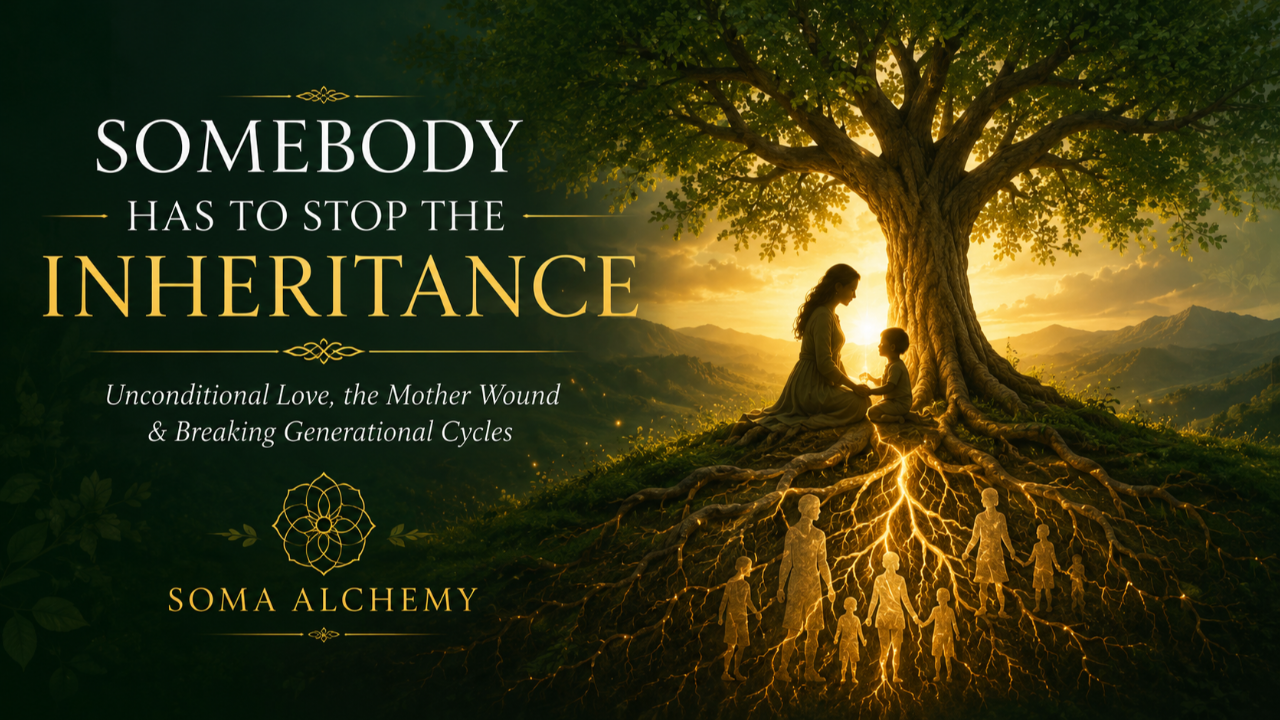
Somebody Has to Stop the Inheritance
I don't believe most human beings entered this world filled with hatred.
I believe we came here reaching for connection.
Then families handed us wounds they had inherited.
Religion sometimes handed us shame.
Culture told us who we were supposed to become.
Gender taught many women to disappear into caregiving and many men to disappear from their own vulnerability.
Trauma taught nervous systems how to survive.
And wounded people built and reinforced systems that created more wounded people.
Systems wounded people.
Wounded people reinforced the systems.
And now conscious people are being asked to break the cycle.
This is where consciousness changes the story.
We may inherit something without choosing its origin.
But once we can see it, we have an opportunity to decide whether it continues through us.
That is where I believe free will becomes sacred.
Not because we are free from conditioning.
Not because our histories disappear.
But because awareness creates a space between inheritance and repetition.
And inside that space lives choice.
Unconditional Love Does Not Mean Unlimited Access
This lesson took me much longer to understand.
Unconditional love is not unconditional tolerance.
I can love someone and refuse to participate in their destruction.
I can understand someone's trauma without volunteering to become the place where they discharge it.
I can forgive someone without restoring the same access to me.
I can recognize the wounded child inside another adult while still holding that adult responsible for what they do with their wounds.
And perhaps most importantly:
I can love someone without abandoning myself to prove it.
Love can be unconditional while access is not.
Forgiveness does not erase accountability.
Understanding does not require self-abandonment.
Our wounds may explain us, but eventually they cannot remain our excuse.
My son began teaching me about unconditional love when I was 15 years old.
It has taken me decades to understand the rest of the lesson.
Maybe we aren't here to perfectly escape everything previous generations handed us.
Maybe we're here to become conscious enough to recognize what we're holding.
To keep what was love.
To grieve what was harm.
To understand what was survival.
And then to decide what ends with us.
Somebody has to stop the inheritance.
Maybe that's why we're here.
— Soma Alchemy
STAY CONNECTED TO SOMA ALCHEMY
Receive new Journal writings, Institute updates, upcoming offerings, and thoughtful resources exploring healing, transformation, and conscious living.
Your inbox is sacred, too. No spam. Your information will never be sold or shared.