
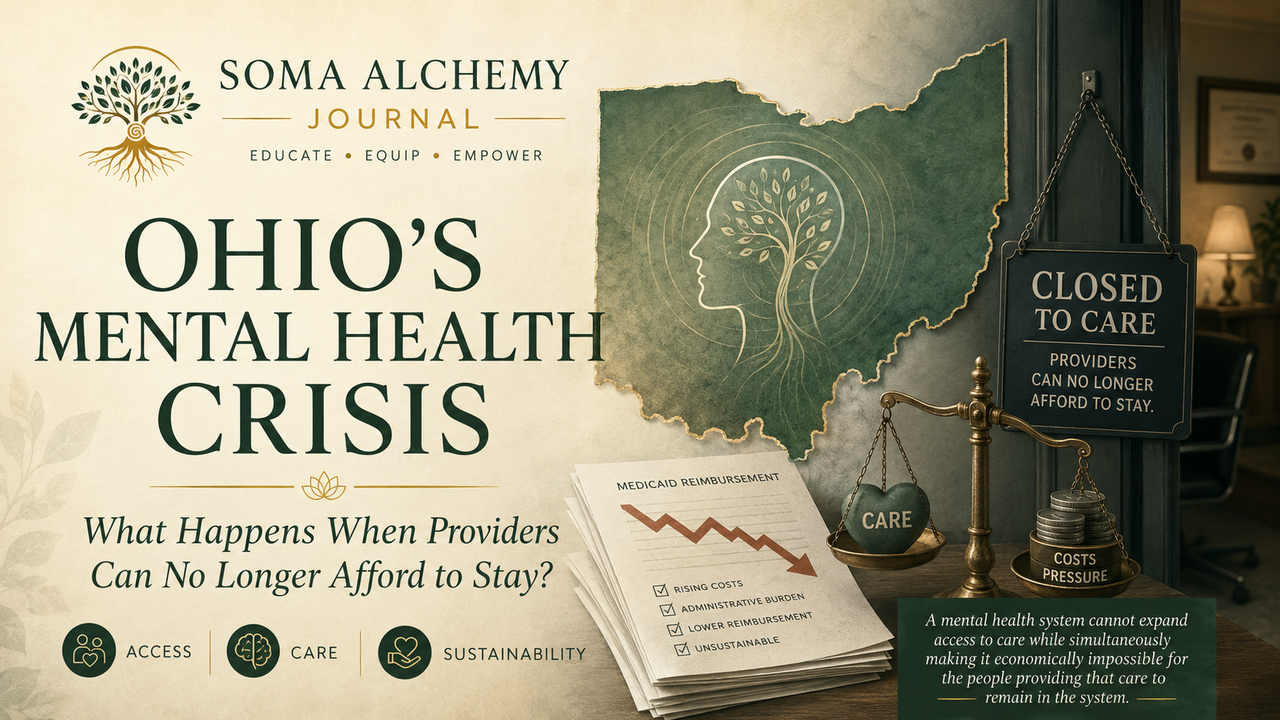
Ohio’s Mental Health Crisis Is Growing — And Providers Are Being Pushed Out of the System
Aug 10, 2026Ohio has a mental-health access problem.
That is not new.
What receives far less public attention is another problem developing underneath it:
The professionals expected to provide that care are increasingly being asked to operate within reimbursement and administrative systems that many small practices cannot sustainably absorb.
And when behavioral-health providers leave insurance networks, reduce Medicaid caseloads, or close practices altogether, this does not remain a “provider problem.”
It becomes a patient-access problem.
We Cannot Solve a Mental-Health Workforce Crisis Without Talking About the Workforce
Ohio has spent years acknowledging shortages in its behavioral-health workforce and the difficulty many communities face accessing timely mental-health care.
Yet access to insurance is not the same thing as access to treatment.
A Medicaid card does very little for a person who cannot find a clinician accepting new patients, cannot locate a specialist who accepts their insurance, or discovers that the provider they have trusted for years can no longer afford to remain in their insurance network.
If Ohio wants to expand access to mental-health care, then the economic sustainability of the professionals providing that care must become part of the conversation.
What Happened With CareSource in 2026?
Earlier this year, behavioral-health providers in Ohio began receiving notices from CareSource regarding reimbursement rates and previously paid claims.
CareSource stated that it had historically reimbursed some behavioral-health providers at 100% of the Medicaid fee schedule when those providers should have been reimbursed at 85%.
There is an important fact that needs to be acknowledged here:
Ohio Medicaid regulations do establish different reimbursement percentages based upon the type of professional providing the behavioral-health service.
Under the applicable Ohio Medicaid rule, behavioral-health services other than testing rendered by physicians, advanced practice registered nurses, physician assistants, and licensed psychologists are reimbursed at 100% of the applicable Medicaid amount.
Services rendered by licensed practitioners or supervised practitioners are reimbursed at 85%.
So the controversy is more complicated than simply saying an insurance company arbitrarily decided to cut therapists' reimbursement by 15%.
The much larger issue involved what happened next.
CareSource initially sought repayment from affected providers for previous payments it said had been overpaid, reportedly reaching backward for two years.
Think about what that means for a small healthcare practice.
Services had already been provided.
Employees and contractors had already been paid.
Rent had already been paid.
Taxes had already been paid.
Business expenses had already occurred.
Providers had submitted claims, and the insurance company itself had processed and paid those claims.
Then providers were told that money already received for completed services was potentially owed back.
After significant provider pushback and concerns that the recoupments could create financial hardship and interfere with members' access to care, CareSource announced that it would suspend those retroactive recoupments.
Future claims, however, would continue to be reimbursed at what CareSource identified as the correct contractual rate.
Stopping the clawbacks addressed one immediate crisis. It did not resolve the larger question of sustainability.
Why a 15% Difference Is Not “Just 15%”
To someone outside private practice, a reimbursement difference of 15% may not sound catastrophic.
But insurance reimbursement is not a clinician's salary.
That payment supports the entire infrastructure required to deliver healthcare:
Rent.
Payroll and contractor compensation.
Malpractice and liability insurance.
Electronic health-record systems.
Billing services.
Credentialing.
Continuing education.
HIPAA compliance.
Cybersecurity.
Accounting.
Taxes.
Administrative staff.
Technology.
Utilities.
Professional licensing.
And countless other expenses required to operate a legitimate healthcare practice.
Those expenses have risen substantially over the more than two decades I have worked in this field.
Yet in my own experience as an Ohio behavioral-health provider and practice owner, reimbursement has not remotely kept pace with the increasing financial and administrative cost of providing care.
I have practiced for more than 20 years. My own financial records tell part of that story: despite accumulating decades of experience, advanced training, additional credentials, supervisory responsibility, and practice ownership, comparable amounts of clinical work have not produced anything resembling the income growth one might expect across that span of time.
That is my personal financial history—not a substitute for a statewide reimbursement analysis—but it reflects the economic reality I have experienced while working inside this system.
And eventually every provider must ask:
Can I afford to continue doing this?
I Have Seen What Happens When the Payment System Breaks
This is not an abstract concern for me.
I have lived through it before.
In 2012, I founded my first group private practice, Core Cognitions, in Northeast Ohio.
We were building something relatively unusual for the time: an integrative model that brought traditional psychotherapy into a broader healing environment alongside complementary and holistic practitioners and services.
During approximately 2013–2014, CareSource initiated an audit involving a small sample of records from the practice.
During the ensuing process, payments to the practice were interrupted.
What happened next was a domino effect.
Providers had already performed services.
Contractors needed to be paid.
The practice still had operating expenses.
When reimbursement stopped flowing, those obligations did not.
I continued trying to pay the people who worked with me using every resource I had available.
A June 16, 2014 email I sent to the remaining providers documents just how far that went.
I explained that I had exhausted available business funds, used my own personal money, sold business property, and even used money from my children's child support in an effort to pay providers what they were owed.
By that point, the business account had been closed and the practice had ceased operating. I explained that any future payments would have to be handled through my attorney and bankruptcy trustee.
I also documented that CareSource still owed the practice enough money to cover what remained owed to providers, that my final appeal had not received a response, and that pursuing those funds was now in the hands of the bankruptcy trustee.
Ultimately, Core Cognitions closed and I filed bankruptcy.
I later received correspondence regarding the audit that, as I remember it, did not result in a finding of wrongdoing. I no longer possess that letter, so I cannot independently document its exact wording today.
I am deliberately transparent about that distinction.
My experience with one practice more than a decade ago does not prove what is occurring in every behavioral-health practice in Ohio today.
But it taught me something I have never forgotten:
A behavioral-health practice can be clinically valuable, deeply needed by its community, and still collapse when the financial infrastructure supporting that care stops functioning.
That is why today's conversation feels so important to me.
I know what happens downstream when reimbursement disruption becomes financially impossible to absorb.
Providers Cannot Simply “Absorb” Everything Forever
Mental-health care is a helping profession.
It is also a profession.
Behavioral-health clinicians complete years of education, supervised clinical experience, licensing examinations, continuing education, and ongoing professional training.
Practice owners carry additional responsibility for compliance, payroll, contracting, credentialing, audits, billing, technology, documentation, privacy, and operations.
Compassion does not pay the rent.
Professional commitment does not pay employees.
And asking clinicians to subsidize an underfunded healthcare system with their own financial instability is not a sustainable workforce strategy.
The Double Standard We Rarely Talk About
There is another part of this conversation that is uncomfortable to discuss, but important.
Healthcare organizations increasingly and appropriately recognize that healthcare workers should not be expected to tolerate threats, harassment, intimidation, or violence simply because they chose a helping profession.
Walk through major hospital systems and you will see reminders that abusive and threatening behavior toward healthcare workers will not be tolerated.
That protection is appropriate.
Behavioral-health professionals deserve that same protection.
Yet there remains a cultural expectation that therapists and other mental-health professionals should somehow be able to absorb more because understanding difficult human behavior is part of our profession.
We work with people who may be traumatized, dysregulated, grieving, suicidal, angry, frightened, intoxicated, psychotic, overwhelmed, or in crisis.
Understanding the clinical reasons behind someone's behavior is part of our job.
But understanding a behavior is not the same thing as consenting to be harmed by it.
Mental-health clinicians are expected to remain regulated when someone else is not.
We de-escalate.
Maintain therapeutic boundaries.
Assess suicide and violence risk.
Protect confidentiality.
Document carefully.
Recognize changes in functioning.
Maintain continuity of care.
Respond appropriately to crises.
Remain compassionate.
And simultaneously, many behavioral-health professionals operate under reimbursement structures that value their services at a lower percentage than several other healthcare disciplines.
Ohio Medicaid's reimbursement structure makes that difference particularly visible.
For behavioral-health services covered under the applicable rule, physicians, advanced practice registered nurses, physician assistants, and licensed psychologists receive 100% of the applicable Medicaid amount, while services rendered by licensed practitioners and supervised practitioners are reimbursed at 85%.
This is not an argument that physicians, nurses, psychologists, physician assistants, or anyone else in healthcare should receive less.
They should not.
The question is why behavioral-health professionals should be expected to carry substantial clinical responsibility, interpersonal risk, documentation requirements, and professional accountability while their work is simultaneously assigned a lower reimbursement percentage.
Trauma-Informed Care Has to Include the Provider
Mental-health professionals are taught to understand behavior through context.
We understand that trauma can contribute to anger.
Fear can contribute to aggression.
Attachment injuries can contribute to difficult relational patterns.
Substance use can alter behavior.
Severe psychiatric symptoms can affect judgment and impulse control.
None of that means the person providing treatment ceases to have a nervous system.
A clinician repeatedly exposed to threats, hostility, crisis, intimidation, or intense emotional interactions is still a human being experiencing those interactions.
Trauma-informed care must include the nervous system and safety of the provider too.
We cannot build sustainable behavioral healthcare by requiring clinicians to demonstrate endless compassion for everyone except themselves.
Empathy and boundaries can coexist.
Compassion and accountability can coexist.
Understanding someone's suffering does not require accepting abuse.
Protecting a clinician's safety does not make that clinician less therapeutic.
Higher Accountability Should Not Mean Lower Value
Behavioral-health providers also operate within significant professional-development, ethical, and licensure requirements.
Ohio social workers are required to complete 30 clock hours of continuing professional education for license renewal, including ethics education. Independent social workers with a supervision designation also have specific continuing-education requirements in supervision.
Other healthcare professions have substantial continuing-education requirements as well.
So this is not an argument that behavioral-health professionals are regulated while medical professionals are not.
The larger point is that behavioral-health professionals are healthcare professionals.
We carry licensure requirements.
Ethical responsibilities.
Documentation requirements.
Clinical liability.
Continuing-education obligations.
Risk-management responsibilities.
And responsibility for the welfare of the people entrusted to our care.
Yet Ohio's Medicaid reimbursement structure still explicitly assigns many behavioral-health practitioners 85% of the applicable amount while several other healthcare disciplines providing behavioral-health services receive 100%.
That disparity deserves examination alongside the state's behavioral-health workforce shortage.
Because when we ask professionals to accept lower reimbursement, increasing administrative burden, significant clinical responsibility, high emotional labor, and sometimes substantial interpersonal risk, we should not be surprised when some eventually conclude that remaining in the system is unsustainable.
We cannot demand healthcare-level accountability while refusing to assign healthcare-level value to the people providing the care.
And the Administrative Burden Continues to Grow
Reimbursement is only one part of the equation.
Behavioral-health providers also operate within increasingly detailed documentation and compliance requirements.
CareSource, for example, published a Behavioral Health Time-Based Service Documentation Requirement in July 2026 as part of its Ohio Medicaid provider updates.
Documentation standards matter.
Medical necessity matters.
Accurate records matter.
Accountability matters.
I am not arguing otherwise.
But administrative requirements also require time.
Every additional documentation rule, billing requirement, audit response, appeal, credentialing task, and insurance correction consumes resources that are not spent providing direct patient care.
For a large health system, those responsibilities may be distributed across compliance departments, billing teams, attorneys, administrators, credentialing departments, and support staff.
In a small behavioral-health practice, many of those responsibilities ultimately land on the clinician or practice owner.
That difference matters.
Understanding the 85% Rule Does Not End the Conversation
The current Ohio Medicaid reimbursement rule is real.
That means the public conversation should not be reduced to:
“CareSource randomly decided to cut therapists' pay by 15%.”
The more important questions are harder.
If providers were being reimbursed at 100% for years, why?
What did their contracts and fee schedules communicate?
How were providers expected to identify that payments processed and issued by the insurer were allegedly incorrect?
What responsibility does an insurer have when its own payment system repeatedly reimburses claims at a rate it later determines was wrong?
What happens to a small healthcare practice when money received in good faith for services already delivered is suddenly subject to retroactive recovery?
And perhaps most importantly:
Even when the reimbursement is technically consistent with an existing rule, is that reimbursement sufficient to maintain the behavioral-health workforce Ohio says it desperately needs?
Compliance with a reimbursement rule and sustainability of a healthcare system are not the same question.
This Is Ultimately About Patients
When providers leave Medicaid networks, the consequences do not disappear.
Patients lose established clinicians.
Waiting lists grow.
Other providers inherit larger caseloads.
Families spend more time calling offices that cannot accept new patients.
People delay treatment.
Symptoms worsen.
Continuity of care is disrupted.
Crisis services and emergency departments may become the place people turn when outpatient care cannot be found.
And the clinicians who remain carry more of the burden.
This creates a vicious cycle:
Fewer sustainable providers → less access → greater pressure on remaining providers → greater burnout → fewer sustainable providers.
Ohio cannot acknowledge a behavioral-health workforce shortage while ignoring the financial conditions under which that workforce is expected to operate.
We Cannot Build Access by Driving Providers Away
Ohio needs accountability in healthcare.
Insurance companies should be able to audit claims.
Providers should maintain appropriate documentation.
Fraud and improper billing should be addressed.
But accountability must work in both directions.
Providers need predictable contracts.
Transparent reimbursement policies.
Timely payment.
Meaningful appeal processes.
Clear communication.
Reasonable administrative requirements.
Safety.
And reimbursement capable of supporting the actual cost of delivering professional healthcare.
If we want more people to enter behavioral-health professions, we have to create conditions that allow them to remain there.
If we want Medicaid recipients to have genuine access to mental-health care, having an insurance card is not enough.
There must actually be a provider available who can afford to accept it.
A mental-health system cannot expand access to care while simultaneously making it economically impossible for the people providing that care to remain in the system.
Behavioral healthcare is healthcare.
It is time we funded, protected, and treated the professionals providing it accordingly.
And we need to have that conversation before more providers decide that staying in the system is simply no longer possible.
Sources & Further Reading
Linked sources are provided below for further reading and verification.
Ohio Administrative Code 5160-8-05 — Behavioral Health Services: Other Licensed Professionals
Establishes covered behavioral-health services and the applicable reimbursement percentages for different categories of licensed professionals.
Ohio Administrative Code Chapter 4757-9 — Continuing Education
Establishes continuing professional education requirements for Ohio counselors, social workers, and marriage and family therapists.
CareSource Ohio Medicaid — Updates & Announcements (2026)
Includes the July 14, 2026 Behavioral Health Time-Based Service Documentation Requirement and other provider policy updates.
Dayton Daily News reporting, May 1, 2026 — CareSource Reverses Course on Recouping Overpayments From Some Behavioral Health Providers
Documents CareSource's original plan to recover approximately two years of alleged overpayments, provider concerns about financial strain and access to care, and CareSource's subsequent decision to suspend the recoupments.
Author's contemporaneous records, June 16, 2014
Personal correspondence documenting the financial impact of the Core Cognitions closure and outstanding CareSource payments at that time.
A Note From the Author
I write this as an Ohio independently licensed social worker and supervisor, behavioral-health practice owner, and clinician with more than two decades of experience in the field.
Portions of this article describe my firsthand professional experiences. I have intentionally identified those experiences as such rather than presenting them as evidence that every Ohio provider or practice has experienced the same circumstances.
My purpose in sharing this is not to attack another healthcare profession, individual provider, or organization.
It is to ask a question that matters to every Ohioan who may someday need mental-health care:
What happens to access when the people providing the care can no longer afford to remain in the system?
STAY CONNECTED TO SOMA ALCHEMY
Receive new Journal writings, Institute updates, upcoming offerings, and thoughtful resources exploring healing, transformation, and conscious living.
Your inbox is sacred, too. No spam. Your information will never be sold or shared.