My Work With Men Started the Moment I Was Conceived
Aug 28, 2026The Wounded Masculine, Inherited Trauma, and the Becoming
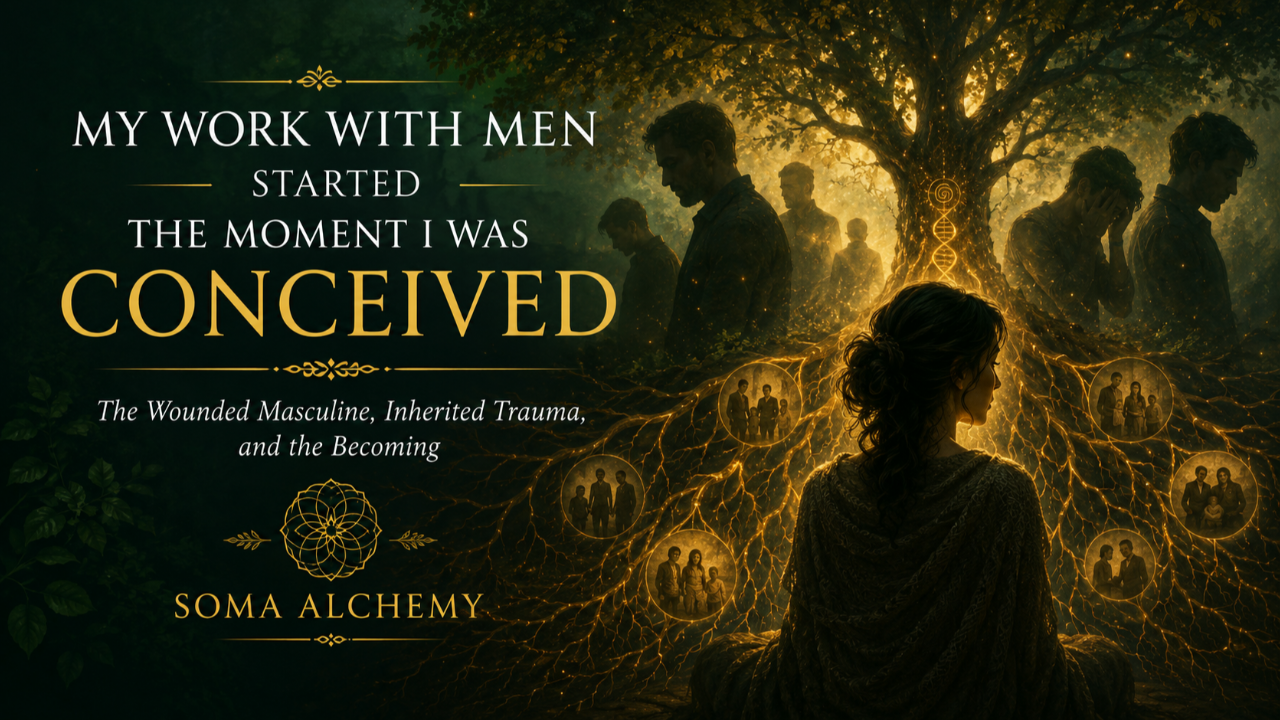
My work with men started the moment I was conceived.
One can argue, How could you possibly know that?
My answer is simple:
I just know.
I cannot prove it.
I am not asking you to believe it.
I am describing a knowing that has followed me throughout my life—one that my studies in transpersonal psychology, more than two decades of professional work, spiritual experiences, relationships, and personal healing have gradually helped me understand.
My work has taken me into places some people have yet to consciously see, but places I believe all of us have been.
And when I follow my own story backward, I arrive somewhere extraordinary:
Before birth.
Before childhood.
Before attachment had a name.
Before I knew what a mother wound, nervous-system response, addiction, avoidance, or generational trauma was.
I arrive at conception.
Before I Was Their Daughter
Within my transpersonal understanding, I believe I chose my parents.
I experience a knowing of them before they knew one another—a sense of observing these two human beings and somehow understanding that their coming together would create the conditions necessary for my own becoming.
My father came from a relatively small Christian family.
My mother came from an enormous, intense Sicilian and Calabrese family rooted deeply in strict Roman Catholicism.
Their histories were different.
Their wounds were different.
Their energy was different.
My father carried a joy that I could feel.
My mother carried something heavier.
Grief.
Emptiness.
The absence of a father.
And my father would eventually experience an enormous attachment loss of his own—the loss of his mother.
Two wounded warriors carrying generations they didn't yet know they were carrying.
But aren't we all?
Somehow, I knew these two people together would create me.
I would become my father's first “Daddy's little girl.”
And somewhere inside that excitement lived the beginning of another lesson.
The First Freeze
This is where my story becomes difficult to explain using ordinary language.
I experience what feels to me like a memory or knowing surrounding conception itself.
I remember intensity.
Movement.
A race toward the egg.
And I remember freezing.
I didn't race.
I didn't compete.
I watched.
I experienced everything moving past me while I remained still, isolated and observing.
I was devastated by what I sensed awaited me.
And yet underneath the freeze was another knowing:
There was nothing to fight for.
That egg was mine.
So I let them pass.
I observed.
Decades later, I cannot ignore the symbolism.
Because observation became one of the greatest survival skills of my life.
I learned to watch people.
To feel shifts in energy.
To recognize contradictions.
To notice what wasn't being said.
To see the difference between someone's words and what their body, behavior, or nervous system communicated.
What began as observation became adaptation.
What became adaptation eventually became skill.
And what became skill eventually became part of my work.
My First Wounded Man
My father was the first man I loved.
And he was my first introduction to something I would encounter repeatedly throughout my life:
the push-pull of the wounded masculine.
Joy and fear.
Love and detachment.
Connection and withdrawal.
Wanting closeness while simultaneously becoming overwhelmed by what closeness requires.
Within my subjective experience of the womb, I understand myself as having felt that conflict very early.
My father was excited.
But he was also terrified.
How could he support my mother and now three children?
How could they survive financially?
We were poor.
My mother carried her own wounds and emptiness into that pregnancy.
And I experienced myself developing inside an emotional environment where love, fear, grief and detachment existed together.
I obviously could not have named any of this then.
But eventually I would spend much of my life studying exactly what I had first experienced there.
Then Came the Men
Throughout my life, I became drawn to wounded men.
The very men women are frequently warned to stay away from.
Detached.
Avoidant.
Depressed.
Addicted.
Emotionally unavailable.
Sometimes incredibly loving.
Sometimes raging.
Men who could desperately want connection and then disappear when connection became too vulnerable.
Men who could remain emotionally numb until something penetrated the armor—and then explode.
Men who blamed others for emotions they did not yet know how to hold themselves.
And repeatedly, I encountered men searching for something—anything—that could create distance between themselves and what they couldn't tolerate feeling.
Alcohol.
Drugs.
Pornography.
Sex.
Work.
Phones.
Gaming.
Technology.
Television.
Anything capable of numbing, distracting, stimulating, escaping or regulating.
I knew this pattern.
I had known pieces of it my entire life.
What Lives Beneath the Behavior?
Eventually, observing behavior wasn't enough for me.
I wanted to know what lived underneath it.
Underneath detachment, I often found pain.
Underneath avoidance, fear.
Underneath rage, powerlessness.
Underneath addiction and compulsive behavior, attempts to regulate internal states that felt unbearable.
Underneath emotional unavailability, sometimes a nervous system that had learned long ago that vulnerability wasn't safe.
And underneath many wounded men were once wounded boys.
Boys who learned:
Don't cry.
Be strong.
Handle it yourself.
Don't be weak.
Provide.
Perform.
Protect.
Don't need anybody.
Then those boys become men and we wonder why some cannot identify what they're feeling, tolerate vulnerability, ask for help, remain present during conflict, or experience intimacy without simultaneously fearing it.
We teach boys to disconnect from themselves.
Then condemn men for being disconnected.
That contradiction matters.
But there is another truth that matters just as much:
Understanding why someone behaves a certain way does not remove their responsibility for what they do.
Trauma may explain behavior.
It does not give someone permission to traumatize another person.
And Then There Were Their Mothers
Again and again, another pattern emerged.
The mother wound.
But the deeper I looked, the less willing I became to simply blame mothers.
Because I began asking another question:
Who wounded the mother?
Many mothers were themselves raised by emotionally unavailable parents.
Women were taught for generations that goodness meant sacrifice.
That motherhood meant selflessness.
That marriage meant endurance.
That sexuality carried shame.
That their value came through caregiving, obedience, beauty, service, or their ability to hold a family together.
Some lived inside religions and cultures that revered motherhood while simultaneously restricting female autonomy.
Some were financially trapped.
Some were traumatized.
Some were overwhelmed.
Some had never experienced secure attachment themselves.
Some were expected to emotionally regulate entire households while nobody ever asked who was regulating them.
The wounded mother did not emerge from nowhere.
Neither did the wounded father.
Wounded women raised wounded boys.
Those boys became wounded men.
Those men partnered with wounded women.
Those relationships created children.
And another generation inherited what nobody had yet learned how to name.
When Understanding Becomes Rescue
This is where my own lesson became painful.
Because understanding wounded men can become dangerous for women who have been conditioned to nurture.
Once you understand the wound beneath someone's behavior, it becomes very easy to tell yourself:
He isn't trying to hurt me. He's triggered.
He is withdrawing because intimacy scares him.
His addiction is an attempt to regulate.
His rage comes from powerlessness.
If I remain calm enough...
If I love him enough...
If I become safe enough...
If I don't abandon him...
If I can just help him see what I see...
Maybe he will heal.
And suddenly compassion becomes self-abandonment.
I know that pattern intimately.
It has taken me years to understand that recognizing someone's wounded child does not require allowing their adult self to wound me.
Women are not rehabilitation centers for wounded men.
Love is not treatment.
Compassion is not consent to mistreatment.
Understanding someone's nervous system does not make me responsible for regulating it.
And spiritual understanding does not require remaining inside destructive relationships.
This distinction has become foundational to my work:
I want to understand the wounded masculine without sacrificing the feminine to save it.
I Was Learning Its Language
For years, I could have asked:
Why do I keep encountering this?
Why these men?
Why addiction?
Why avoidance?
Why detachment?
Why rage?
Why do I keep walking toward precisely what everyone tells me to avoid?
Eventually the question changed.
Maybe I wasn't repeatedly encountering the wound because I was meant to remain trapped inside it.
Maybe I was learning its language.
First through my father.
Then through relationships.
Then through education.
Then through clients.
Then through research.
Then through my own healing.
The pattern became increasingly visible.
What once looked like unrelated experiences began to reveal an architecture.
And once I could see the architecture, I could begin separating two things I had confused for much of my life:
Understanding the wound and carrying the wounded person are not the same thing.
That distinction changed everything.
The Wounded Masculine Is Not the Enemy
I don't believe men are the problem.
Nor do I believe women are.
I believe unconscious inheritance is.
A wounded masculine can become destructive.
So can a wounded feminine.
The expressions may differ.
The defenses may differ.
The cultural permissions may differ.
But underneath both are human beings adapting to environments, relationships and systems that existed before they had language for what was happening.
Men have been wounded by patriarchal systems too.
A culture that tells a boy his worth comes from strength, productivity, sexual performance, money, status, emotional control and his ability to provide is not teaching him wholeness.
It is teaching him conditions for worthiness.
And when he inevitably cannot satisfy all of them, shame waits.
Some men turn that shame inward.
Some numb it.
Some disappear.
Some become depressed.
Some become addicted.
Some rage.
Some project it onto women.
Some blame their mothers.
Some repeat what was done to them.
Understanding that matters.
And accountability matters.
Healing requires both.
Somebody Has to Stop the Inheritance
This is where my work with the wounded masculine intersects with something larger.
Women inherited wounds.
Men inherited wounds.
Mothers carried what their mothers carried.
Fathers carried what their fathers could not speak.
Children absorbed both.
Generation after generation passed survival forward and called it normal.
Until somebody became conscious enough to see it.
Somebody has to stop the inheritance.
Not through blaming mothers.
Not through blaming fathers.
Not through hating men.
Not through asking women to save them.
Not through pretending trauma didn't happen.
And not through using spirituality to excuse harm.
We stop the inheritance by seeing clearly.
By recognizing what belongs to us and what never did.
By understanding our adaptations without turning them into identities.
By grieving.
By taking responsibility.
By learning regulation.
By practicing boundaries.
By choosing differently when the old pattern asks to repeat itself.
Consciousness does not erase the wound.
It changes our relationship to it.
I Did Not Come Here for Small Work
At 45 years old, something has become extraordinarily clear:
I did not come here for small work.
For much of my life, I have struggled with being on this planet at all.
Yet paradoxically, I have rarely felt more certain that there is something I am supposed to do while I am here.
Every relationship.
Every wound.
Every loss.
Every chaotic chapter.
Every person who activated something buried inside me.
Every moment I wondered:
Why the fuck am I doing this again?
Perhaps none of it was asking me to remain inside suffering.
Perhaps it was teaching me its architecture.
I came here to observe.
To question.
To enter the places people are afraid to look.
To understand the wounded masculine without making men the enemy.
To understand the wounded feminine without asking women to become the medicine.
To bring psychology into conversation with spirituality.
To bring nervous-system understanding into conversation with consciousness.
To recognize what generations before us could not yet name.
And then to ask:
What becomes possible when we stop unconsciously repeating what we inherited?
The Becoming
Something has shifted.
The calling feels louder now.
Almost like a siren before a storm:
Take shelter.
Stay focused.
Be mindful.
Remain conscious.
Build a container strong enough to hold what is coming without allowing it to destroy you.
For years, I might have interpreted the container as protection from the world.
I understand it differently today.
The container isn't a wall.
It isn't avoidance.
It isn't detachment.
It is the capacity to remain rooted in myself while standing close enough to suffering to understand it.
Without becoming it.
Without carrying it.
Without allowing it to consume me.
Perhaps the first 45 years weren't simply a collection of unrelated experiences.
Perhaps they were preparation.
Observation became survival.
Survival became understanding.
Understanding became consciousness.
And what becomes conscious no longer has to remain inherited.
The wounded masculine does not need another woman willing to disappear in order to save him.
He needs the opportunity—and ultimately the responsibility—to become conscious of himself.
And the wounded feminine does not need to harden herself against men in order to survive them.
She needs permission to remain compassionate without abandoning herself.
Maybe that is where something new begins.
Not masculine against feminine.
Not mother against son.
Not victim against perpetrator.
But human beings finally becoming conscious enough to see what they inherited—and courageous enough to stop handing it forward.
The mission is clear.
The calling is loud.
The becoming is here.
— Soma Alchemy
STAY CONNECTED TO SOMA ALCHEMY
Receive new Journal writings, Institute updates, upcoming offerings, and thoughtful resources exploring healing, transformation, and conscious living.
Your inbox is sacred, too. No spam. Your information will never be sold or shared.